Originally published in The Occult Review, 1908, v7 May p259.
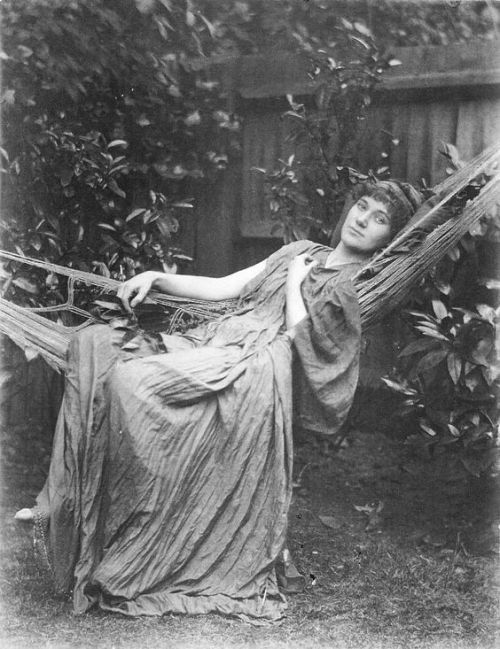
Florence Farr
A LEGEND arose in the time of the Lutheran outburst of a mysterious master called Christian Rosenkreutz, who was buried for a period of all years in the central cavern of the earth. His shrine was seven-sided, and all the symbols of the universe were said to have been found disposed round him in this place. The Egyptian tradition of Seker, the god in the central cavern of the Duat, evidently found an echo in the heart of the inventor of this legendary father 01 mysteries, and it will be interesting to try and discern the meanings of the main symbols of the Rosenkreutz legends in Egypt and in Germany.
The Egyptian Duat, or Underworld, was represented by a five-foldstar, or star of five radiations, enlarging as they receded from the centre, and therefore not bearing the same symbolism as the pentagram. The Rose is fivefold in its structure and is a well-known symbol of silence. The stages of its existence pass from the bud, or potential state of pralaya, to the unfolding of its leaves as the pleroma, or fulness or manifestation of creative power. Consciousness, thought, reasoning, will, and the sense of individuality are five of its powers; the five senses are other manifestations of the same symbol. When the pollen of a flower is ripe the creative work begins, the petals fall and the fruit and seed are formed. The processes of life are a rhythmic coiling and uncoiling; a radiation and attraction, and an emanation or separation. The fruit coils round the seeds, the juices pass to and fro, and finally the busk of the fruit bursts and the seeds fall out separately as emanations, each complete in itself.
So in the degrees of human enlightenment the purest state is Being so unified and perfect that the kind of consciousness that depends upon comparison cannot exist. The second state is the sense of being without bounds, which is often called wisdom. The third state is discernment, or understanding, and may be attained by concentration of the subjective mind upon an object until full understanding is attained. And these states of the unmanifest consciousness arc called Sat-Chit-Ananda in the Vedantic philosophy and Ain-Soph-Aur in the Kabalistic philosophy; and Ptah-Seker-Osiris was the concrete image of these ideas ill Egypt.
Now the Rose of the Rosicrucians was a more complicated symbol than the Cup. As we have seen the Cup was a symbol of creation, and its form was connected with the symbol of a circle in contrast to the Cross. The symbol of the Rose contains five petals and five divisions of the calyx. It is evidently the symbol of creation in activity, not in potentiality only. Perhaps we may believe the Rose to be a symbol of the subtle body of man, which is one with nature, and the Cross the symbol of the body and the name of word of man. The union of the Rose and Cross would symbolize a man able to unite himself to the great powers of Nature, or tatwas, familiar to us under their Hindoo names Akasa, Vayu, Tejas, Apas and Prithivi, or the kingdoms of sound, sensation, perception. absorption and reproduction more commonly called hearing, touching, seeing, eating and generating.
Now the notion of obtaining the natural powers of an adept is most apparent in the traditions that come through Egypt and Chaldea, and the idea of the super-essential state in contrast to power is most apparent in the Oriental traditions. The high caste Oriental has the aristocratic spirit that conceives the height of life on this world to consist in the delicacy of perception associated with perfect self-satisfaction, while the democratic spirit of the West cannot conceive itself without desires, struggles and potencies for gratifying desires : democracy wishes to do and to have; aristocracy is sufficient unto itself.
Rosicrucianism and Alchemy are both allegories constructed by these working democratic minds, and in the alchemical symbolism we can trace the exact degrees of initiation through which the man, still under the great race delusion of progress, must pass before he realizes that his real self is the same yesterday, to-day and forever.
It is true in a sense that this treasure of all sages, this knowledge of Being which all mystics seek, forms itself vehicles in time and space in which it carries out the imaginations which spring from the relative side of absolute consciousness, and it is interesting to trace the different degrees of attainment.
Alchemical symbolism is mainly the symbolism of distillation.
To take a simple process, let us imagine that we desire to obtain the white and the red tinctures from honey. The alchemist would put the honey in the cucurbite of an alembic. Placing it over a gentle heat be would drive the essential part of the spirit into the bead or beak of the alembic, whence it would pass as steam into the neck of the receiver end become liquid once more as it cooled. This liquid was the white tincture, or spirit of honey mixed with water. This is the symbol of that concentration and meditation whereby the mind of man becomes subtilized and fit to perceive philosophical impressions. The white tincture is the symbol of light and wisdom.
But to obtain the red tincture of power a far more complicated process had to be performed. It consisted mainly of pouring back the distilled spirit upon the black dead-head that had been left as residue in the cucurbite and by the exercise of great care and the addition of certain matters acting upon the mixture in such a way that finally the whole of the original matter .was distilled and no black dead-bead remained and a wonderful red tincture was the result of the transmutation of the black nature.
This symbolical process involves the passing through definite stages of progress in the world of changing life. Let us imagine it carried out to its logical conclusion upon our own earth. We know that the mineral kingdom is the state in which form lasts for infinite ages and can stand great heat and cold without destruction. We know that the giants of the vegetable kingdom last many hundreds of years, but although the process of their growth and decay it prolonged they are not capable of resisting fire or of existing in the frozen zone. We know that certain animals, such as elephants, tortoises and parrots, live for very long periods of time. All these creatures have greater tenacity of existence in the forms or vehicles of life than the human creature.
It is also plain that as the earth becomes more and more subject to violent change, when the great floods and the ice and the burnings visit it, in its old age conscious life must exist in more enduring but 1ess complex, sensitive, visible forms than it does at present. Now consciousness of Being is the name we give to the white tincture which the adept distils from his human form in the alembic of the mind. It is brought about by the fire of imagined emotion and devotion under the stress of intense concentration. To focus thought has the same effect as to focus sunlight. It becomes & force analogous to heat. It is, in a word, emotion evoked by the skill of the sage. In this fire the Adept raises his consciousness until it is separate from the gross body, and no longer aware of the objective world. Passing through the gate of dreams it enters the subjective world and lives in its own brightness. Here it learns that it can create infinite visions and glories, and here the saints rejoice, each in his own heaven. Here finally the sage perceives his own divinity and is united to his God. This is the white initiation in the eyes of the Rosicrucian doctors, and according to the scriptures of the alchemists the sage has gained the white tincture. The objective world only remains in his consciousness as blackness and ignorance and death. In his divine nature he seeks to redeem the dark world, to draw it up into the divine nature and make it perfect. His vision can now show him a world in which man can no longer exist in material human form. His own desire for wisdom has drawn up the human element out of the visible or objective state. He is no longer merely a man in a human body because his subtle body has possessed itself of the characteristic human faculty of self-conscious comparison, the origin of wit, laughter and criticism.
The humanity that is beyond animal consciousness has the power of acting and knowing at the same moment; it can seem one thing and know at the same time that it is another. It is not a noble quality; it is nothing more than the power of laughing at ourselves: and yet it is the great redeeming quality, for it is the germ of all wisdom and enlightenment.
The ordinary dreamer lives in his subtle body as the fool of his own fancy, and the dream shows how little human wisdom his subtle body has obtained: but the subtle body of an adept can perceive the illusionary formulation of panoramas of light and form arising from the half-seized impression of light falling at a certain angle across the red edge of a blanket and the linen of a sheet just as he closes his eyes. The dream of the sage is a consciously guided dream. Like an author, he writes his own dramas and delights in the joys and tragedies of his creation, He no longer suffers from the attacks and sorrows that his own mind creates, but observes them with excitement and interest. He watches his own tears and cuts into the heart of his own emotions.
These are some of the experiences of the sage who has transferred the human principle from the body of matter to the subtle body.
The material body may in this stage of enlightenment be considered as a beautiful and healthy animal; it carries on the physical functions in temperate ways, unaccompanied by the fantastic imaginations of a human being. And there is little doubt that the bull of Apis was considered to take the place of the body of the adept Osiris in this way. The body of a sacred animal would answer every purpose for the divine man whose invisible body bad attained some degree of complex, conscious life. The nervous forces of the animal world act as the physical basis for the dream-powers of the subtilized or deified man.
In China the flying dragon, the mythical combination of all kinds of animal life, represents the body of the deified man that can command all the elemental states of matter that can exist in the air, the fire, the earth and the water. The dragon is the symbol of the material body of the being who has complete command of the elemental world and afterwards becomes the subtle body in the further stage of being of which we are told in Druid tradition.
When the earth grows older and complex animal forms such as flying-fish and sea-serpents and monstrous alligators, can no longer exist, another symbol must be taken from the writings of the Rosicrucian doctors and the alchemists, and we enter upon the study of the Tree of Life. He who eats of the fruit of the Tree of Life will become one with the Elohim, or creative gods, and will live for infinite ages.
Imagine the world enveloped in a great white cloud, moist and warm like a hot-house ; giant palms and ferns and mosses dripping with moisture: a climate like that of the Cocoa-palm Islands off the west coast of Africa, where animals and men can only live a little time. In this world the adept would use some marvelous tree as the physical basis of his life: and his subtle body would have drawn up into itself all the forces of motion that make a tree less powerful to our minds than an animal. The subtle body in this state would have become a veritable dragon of complex forces. It would have drawn into itself the mixed sphinx-natures of the birds and the fish, the creeping things and the four-footed creatures. The dryad of each tree would be a mighty Druid; the great Pendragon would have his oak as a physical form and would exercise his power in reality as we can imagine the ancient Druid sages exercised theirs in imagination.
This state of the subtle body may perhaps have been symbolized by the Green Dragon of the alchemists, but the Red Dragon arose after still further distillation.
Now we have to imagine a world all fire and molten glory of flame, in which. no tree or flower could exist: a world in which wonderful agate trees would circle the white crystals of their pith with bands of violet and hyacinth and blue melting into stretches of pale chalcedony and shrouded in dark crystal bark, their branches glimmering with emerald leaves: a world in which mineral life has learned at last to show itself in perfect form, where light and fire glowed alternately and played with elemental shapes and images of beauty. And so, at last, we come to the last symbol of the alchemists – the symbol of the final perfection, the Summum Bonum, the Philosopher’s Stone.
Let us imagine what that state would mean for the adept : his gross body a pure ruby, a perfect crystalline form with all the powers of growth, of nourishment, of reproduction drawn from the vegetable kingdom into his subtle body, carried on without disgust or satiety through the beautiful mediums of fiery blossoms and shining leaves ; his subtle body almost visible as a light shining in the fiery world; his children flowers of flame and his physical form an everlasting memory of beauty; his mind an all-pervading consciousness in which blossoming imaginations arose or subsided under the law of his will: a perception unified with a faculty that ordered joy to succeed sorrow and sorrow to succeed joy because he knew that one cannot manifest without the other. A supreme artist, he would rejoice in creation; a supreme critic, he would rejoice in contrast.
So the red tincture would be attained and the black, the white and the red worlds explored and analysed in the imagination of the Rosicrucians and alchemists of the Middle Ages.
We still see the same desire for progress among those who strive for the ancient stone here in this western democratic world of men who desire “to have” and “to do.” But these circles of everlasting recurrence so dear to Friedrich Nietzche are not what he called them. They are not aristocratic.
The aristocracy of mind is shown in the philosophy of Villiers de I’Isle Adam, who cried; “As for living, our servants can do that for us.” It is the feeling of the great Buddhist intellect who sees that in the words “I am not” there is a wonder and a vision and song far exceeding the mere ideas of limited ecstasy and knowledge concealed in the words “I am.”







Transition
From The Sacred Magic of the Angels by David Goddard.
THE ANCIENT GREEKS PORTRAYED their death god, Thanatos, as a beautiful, dark-haired, winged youth. In our Western culture, most births (though by no means all) are generally perceived as “happy” events. Most deaths (though by no means all) are generally perceived as “sad” events. Fortunately, much good work is now being done by thanatologists like Elisabeth Kubler-Ross and Stephen Levine to transform our culture’s view of death, and to empower oth-ers to assist the dying to prepare holistically for their first step on their Journey to Light. Elisabeth Kubler-Ross spoke of her experiences assisting dying children, and of her awareness in such cases of the presence of the Holy Lady Mary and the perfume of roses, giving reality to the prayer Ave Maria: “Holy Mary, mother of God, be with us now and at the hour of our death.” Likewise, “Mother” is the name for God upon the lips and hearts of all children. Hospices, usually presided over by a senior shepherding angel, are a great blessing to the dying.
In reality, the womb and the tomb represent two aspects of a continuous flow. Our perceptions of that flow are simply a matter of which way we are facing. In fact, in ancient lore, the “Gate of Horn” has a sign on its lintel, one side of which says Entrance, the other side of which says Exit. All else is a matter of perspective.
Ideally, at physical death, the prepared soul withdraws calmly from the physical vehicle-the silver cord connecting the physical and the etheric bodies breaks (like the umbilical cord at birth), and the soul is set free upon the astral level. The disembodied soul then translates to the spiritual level, where the incarnation as a whole is assessed by the Higher-Self. What is beneficial is distilled and absorbed by the spirit, what is not is cast out. After the self-judgment, a soul usually passes to a purgative state to work on any blemishes, since few of us emerge from incarnation spotless. After purification, the soul passes to one of the “paradises,” catching up with very, very old friends before the call to go forth comes again. In other cases, where evil has been the keynote of an incarnation, the soul passes to one of the hells until atonement has been made. Our dreams and our nightmares are the frontiers of paradise and hell.
Unlike birth, where the incarnating soul has little effective free will, the transition of death is fraught with pathologies. Others have written extensively on the subject,* so I will confine myself to how death interfaces with the angels.
* Readers might like to explore Dian Fortune’s Through the Gates of Death (London: Aquarian Press, 1987), and C. W. Leadbeater’s The Devachanic Plane (East Sussex, England: Society of Metaphysicians, 1986)
One of the most common pathologies of the after-death experience is the plight of the “earth-bound.” These are souls who either do not believe that they are dead (a very common occurrence for short periods of time, rather like shock), or souls who willfully refuse to leave the Earth plane. Jesus put it very well when he said, “Where your heart is, there will your treasure be also” (Matthew 6:21). If a person’s main focus in Iife – to the virtual exclusion of all else – has been the material realm, it is quite natural for them to gravitate to that realm and not wish to pass to any other. The film Blithe Spirit, and the more recent film Ghost, both deal with examples of the earth-bound condition.
No one should die alone, as Mother Teresa of Calcutta shows us by the example of her work. On the hidden side of life, it is a fact that not a single soul goes out of embodiment unattended. Most individuals at death are met again by their friends upon the long journey, who attended their birth, and by loved ones who have already made their transition. The angels that minister to the dead and dying are sometimes called the “shepherding angels.” They are kin to Angel Cassiel of Saturn and serve under the great Archangel Tzaphkiel.
Not all deaths bring consolation. The transitions of those who have lived lives of evil, willfully inflicting pain and suffering upon others, undergo deaths darkened by fear. Such individuals ate awaited by loathsome, parasitic, shadow-creatures whom they have unknowingly “fed” during life by their actions. These astral carrion relentlessly wait to devour the disintegrating psyche. Also waiting are the victims on the other side who may have decided not to “turn the other cheek” to the evil done to them in life. For just as free will and self-determination do not cease with death, neither does hate or revenge, redemption or love. Even to people who have willfully done much evil there comes, at the moment of transition, a bright angel who will guide them, if they will but clasp the outstretched hand.
Cultures other than ours have wisely sought ways to assist discarnating souls: the Priests of Anubis and Osiris in ancient Egypt, the Priestesses of Persephone in Greece and Rome. In fact, Tibetan Buddhist Lamas still attend the dying and guide them, not only up to the moment of separation from the physical plane, but afterward, guiding them telepathically upon the inner journey. The Jewish recommendation to “accompany the dead” is an esoteric reference to the act of guiding the newly departed safely through the lower astral plane, back to the Spirit who is the “father,” the seed-giver of the incarnate personality – in Hebrew wisdom, esoterically referred to as “the bosom of Abraham.” Spiritualist Rescue Circles and Catholic Requiem Masses also do much good in guiding wandering souls to havens of light, from whence the shepherding angels can take them onward. I have been told of a loose-knit society of Catholic priests who, despite the theologians, offer a Requiem Mass once a month with the intention of releasing a soul from hell.
Deaths that occur suddenly, as a result of violence, accident) or a natural disaster) invariably involve trauma for the newly dead. It has been known that after a fatal plane crash the shepherding angels arrive on the astral scene wearing the mental forms of doctors and nurses. They help distressed and shocked victims, rebuild the astral double of the airplane and then transport the newly disembodied to the simulacrum of an airport, that just happens to be one of the antechambers on the Inner levels to the place of peace. Angels who work with the dying rarely turn up in their own forms except in the case of an advanced soul. They usually wear forms that comfort those making their transition. When events occur that cause multiple fatalities – earthquakes, bombings, etc – incamate humans who have the compassion and the capabilities leave their bodies in trance or sleep, and project on the astral level to the site of the disaster, where they work under the supervision of the shepherding angels. This is one of the meanings or the phrase in scripture which enjoins us to “serve the Most Holy One by night and by day,” and is one of the ways in which angels and humans can cooperate in the service of God.
If you attend the dying, try not to bring fear or sorrow, but endeavor to radiate the assurance that arises from the knowledge of human immortality. Remember, these people are not passing into oblivion. They are only changing worlds. They are shedding a suit of clothes, and will put on a new suit at some future time. Those draw¬ing near the portal of death tend to become very psychic toward the end. It can be very reassuring for them to have someone nearby for whom the unseen holds little fear.
Invoke the shepherding angels to help the transition, to make smooth the way; and welcome them as they come to guide the dying into peace. Then shall the chamber of death become a doorway into Heaven, lit by a glorious Sun such as the Earth has never seen.
1 Comment
Filed under Comment, Supernatural
Tagged as Angelic Magick, Arianna Grande, David Goddard, Manchester, Psychopomp