Ask yourself: why is there this herb or this crystal in the spell in the first place?
The person who originally came up with the spell didn’t put it there at random, they did so because they had a specific plan in mind – a specific reason. You work out what that reason was, and you may realise – there are other methods of achieving the same goal not necessarily using the original herbs or crystals, or indeed any at all.
So yes, if you can breakdown how and why spells are constructed you could do witchcraft without either herbs or crystals, even to the extent of learning to create your own spells. You might even realise that you know more than the person who originally wrote the spell!
Incidentally, I can offer my opinion about herbs and crystals which may help you. The main reason they are used in magic is because they have Astrological properties which coincide with the purpose of the spell. There is more than one way of invoking Astrological energies, this is the sort of thing which can be researched.
Or of course, you may get to the point where although you technically can work without herbs or crystals, you can make an executive decision that working with a herb or crystal is most convenient for you in a particular instance.
A Succubus. Note that in real-life, Succubi tend to appear without horns, wings, tails, and indeed clothes!
In a novel I wrote, The Magus, one of the characters has an authentic experience with a “Succubus.” Whilst trying to evoke a demon and get it to do its bidding, the demon tries to get out of the pact by distracting him with sex in the form of a beautiful woman. Whilst the experience is highly erotic, the man realises that if he is to succeed with his magic he needs to refuse sex with the Succubus and instead force it to agree to do his Will.
In other words, despite the fact that a Succubus might seem attractive to a lonely but horny teenager who is not getting enough in real life, such a demon only manifests when an evocation goes wrong. One cannot deliberately summon a Succubus, as that would entail deliberately failing at an Evocation – but if you set out with the intent to fail, it wouldn’t work to begin with.
“Magical thinking” may be out of place in the hard sciences, but Scientists tend to forget – not everything in this world is Scientific. The most obvious example of which is Art – by which I include literature, music, film & theatre, and just about everything we do for cultural and aesthetic reasons.
In order to appreciate a work of Science Fiction, one has to has to have a Magical Thinking mindset, not a Scientific one, because the plot necessarily requires a suspension of disbelief. The same could also be said for horror fiction, fantasy fiction, etc
It is also necessary to accept Magical Thinking in order to appreciate history itself, since as late as the middle of the twentieth century, the Arts were given greater emphasis in education than the Sciences. There was indeed a time when it was thought that you could get farther in life with a knowledge of the works of (e.g.) Shakespeare than of Isaac Newton. This is not necessarily the view of modern education, but if you didn’t actually realise this then you would fail to understand the decision making processes of the world’s most influential people of the comparatively recent past.
Finally of course, Magical Thinking is a requisite for understanding actual magic. 😉
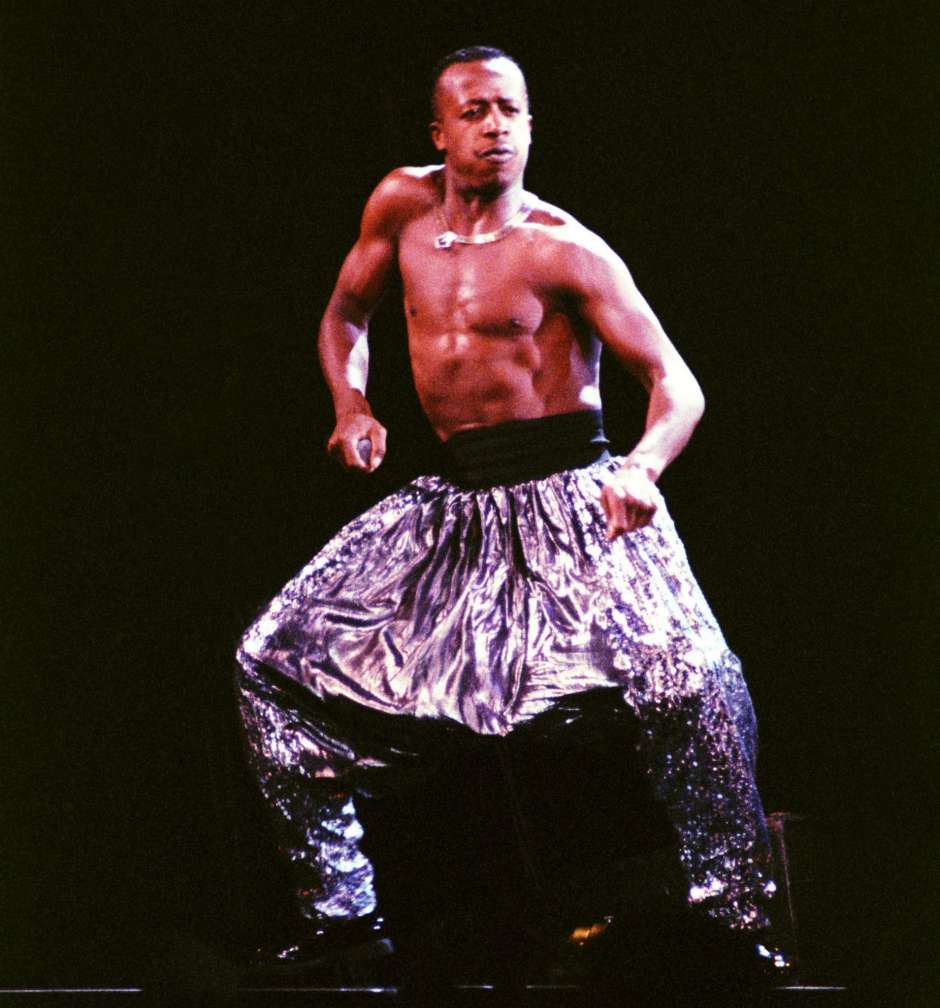
Perhaps this is the ceremonial regalia of an order of which I’m not a member?
This is a follow-up to posts I made last year regarding original Abramelin sources online, to wit: the Dresden Manuscript, the Leipzig Manuscript, and that of the Biblioteque D’Arsenal (which Mathers translated to create the first English edition). All of these posts were basically for my own benefit, so that I at least would know where to go on the internet to find them.
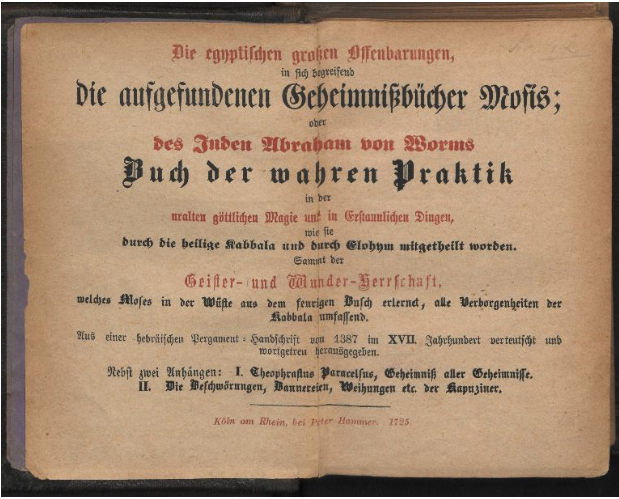
Copy of the Hammer edition of Abramelin held at the Humboldt University of Berlin
I can now add another one: the “1725” Peter Hammer edition. If the date of 1725 is to be believed, this would be the earliest known printing of Abramelin, although I was under the impression that the only available versions of the Hammer edition date from facsimiles made in 1850.
EDIT: No sooner had I published this post but on further searching I actually found a better quality scan – held at the Humboldt University of Berlin. A previous version of this blog post referred to a low quality scan on Internet Archive, which is barely readable. I have now updated the links accordingly.
Incidentally, the attribution of Peter Hammer of Köln (i.e. Cologne) is spurious. There was no such person as “Peter Hammer,” and the imprint wasn’t based out of Cologne, but rather Amsterdam. The fact is that because of the repressive nature of continental Europe the late 17th and early 18th centuries, if you wanted to publish an anonymous book that was in anyway criticial of the monarchies of France or Germany (as was) or was otherwise controversial (e.g. it was a Grimoire which would probably upset the religious authorities), one would take it to “Pierre Martel” (NB Un martel is a kind of hammer) or “Peter Hammer” if in German, who would print it in Amsterdam but say it was done in Germany to throw off the scent.
Interestingly, Mathers himself said that he had heard of an Amsterdam manuscript, so perhaps he actually meant the Hammer edition?
Q: “So were you involved in actual devil worship?”
A: “Not devil worship, no, it was pure straightforward, old-fashioned magic.”
Q: “The Aleister Crowley variety?”
A: “No, I always thought Crowley was a charlatan. But there was a guy called [Arthur] Edward Waite who was terribly important to me at the time. And another called Dion Fortune who wrote a book called ‘Psychic Self-Defense‘. You had to run around the room getting bits of string and old crayons and draw funny things on the wall, and I took it all most seriously, ha ha ha ! I drew gateways into different dimensions, and I’m quite sure that, for myself, I really walked into other worlds. I drew things on walls and just walked through them, and saw what was on the other side!”
David Bowie, interviewed in NME, 1997
It being 2021, this year will inevitably see many five year anniversaries marked, none more keenly felt than that of the great David Bowie, who together with the passing of Lemmy marked the start of the second worst year of recent memory, to wit – the dreaded 2016. The tragedy was so great that it had the effect of drawing the Occult community, which is normally riven by fractious arguments, together to an unprecedented degree. Ironically, this post which I wrote at the time became the most read article ever on my blog.
So the news this week has been dominated by the passing of David Bowie, and when I consider how much attention was paid to the untimely death of Freddie Mercury – the last pop star of comparable status to leave us – it is almost certain that this event will remain in public consciousness for years to come. Anywho: amongst the magical community, it has been widely noted that Bowie was interested in the occult, as witness his interview with NME quoted at the top of this page, and the back cover over the Station to Station LP, below left:
Photo used for the back cover of Station To Station (1976)
Video for Lazarus (2015)
NB: given the amount of Charlie he was packing away at the time, his precise allegiance might well be pinned to the Holy Order of the Sun! Interestingly, Bowie resurrected the costume covered with, ahem, “white lines,” for his almost-certainly-not final music video “Lazarus” (above right). Might not this video be suggesting that David Bowie did not just keep this costume but this persona hanging up in the closet all this time?
But I digress.
There is an image in the Lazarus video on which a number of bloggers have already commented: where Bowie sits frantically writing at a desk, on which rests a skull. Now the obvious interpretation is that it was a reference to Bowie’s own impending mortality, but when I saw it, it stirred the Sumner Family Brain Cell to life, and got me thinking, where have I seen that before?
See: 3minutes 38seconds.
The answer is: it comes from the first degree (Apprentice) ritual of the Ancient & Primitive Rite of Memphis and Misraim – a particularly esoteric form of Freemasonry. Assuming the candidate for initiation passes the ballot, just before the ceremony of his initiation,
…[t]he Expert (i.e. Junior Deacon) then takes possession of the Candidate in the Parvis, carefully binds his eyes and leads him to the Chamber of Reflection. He has him sit before a table, sparingly furnished with a real human Skull; a lit wax Candle, half-consumed; a sheet of white paper, pen and ink. The seat is a stool without a back. He lights a little Myrrh, the traditional funereal perfume, in a corner of the room, in a Censer containing lit coals.
Expert: – Sir, alone, left to yourself, before an image of termination of terrestrial Life, I invite you to write your Philosophical Testament.
The “Philosophical Testament” consists of the candidate’s reflections on his duties to God, the World, and himself: but more especially, like its name suggests, how the candidate would answer these questions if his words were the final legacy which he leaves on Earth. However, the code-word “philosophical” indicates that one is meant to interpret it alchemically. In other words, Death is not the end for the candidate – i.e. for David Bowie – but is the first step on the path to spiritual transmutation.
So, there you have it – Bowie indulging in esoteric symbolism right up until the last!








 Sol Ascendans - The Website of Alex Sumner
How can somebody summon a succubus? – Quora
A Succubus. Note that in real-life, Succubi tend to appear without horns, wings, tails, and indeed clothes!
In a novel I wrote, The Magus, one of the characters has an authentic experience with a “Succubus.” Whilst trying to evoke a demon and get it to do its bidding, the demon tries to get out of the pact by distracting him with sex in the form of a beautiful woman. Whilst the experience is highly erotic, the man realises that if he is to succeed with his magic he needs to refuse sex with the Succubus and instead force it to agree to do his Will.
In other words, despite the fact that a Succubus might seem attractive to a lonely but horny teenager who is not getting enough in real life, such a demon only manifests when an evocation goes wrong. One cannot deliberately summon a Succubus, as that would entail deliberately failing at an Evocation – but if you set out with the intent to fail, it wouldn’t work to begin with.
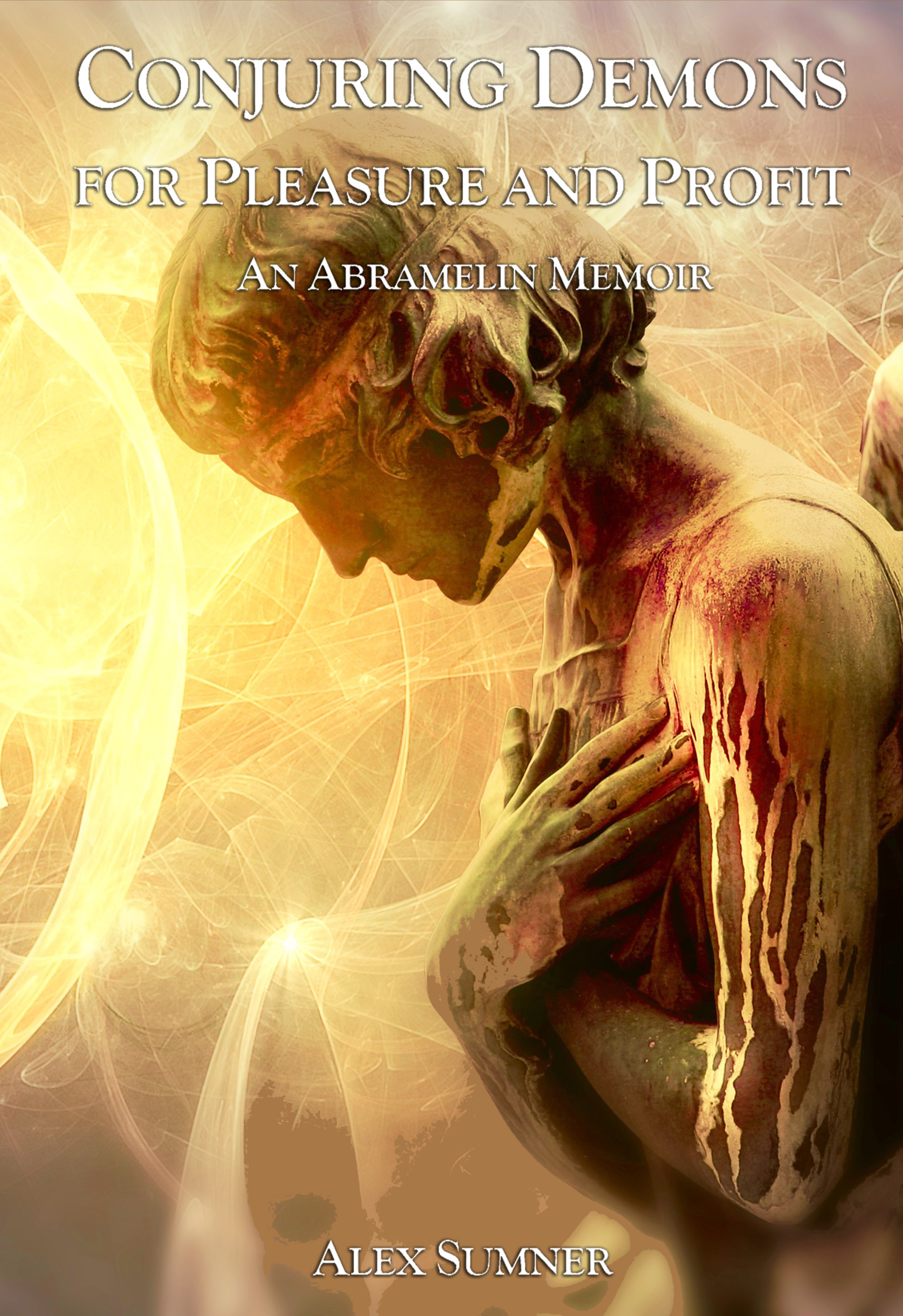
The Magus, by Alex Sumner
Source: Alex Sumner’s answer to How can somebody summon a succubus? – Quora
Leave a comment
Filed under Comment, The Magus
Tagged as ceremonial magic, Demons, evocation, goetia, quora.com, sex, succubus