Reading Caroline Tully’s paper Researching the Past is a Foreign Country: Cognitive Dissonance as a Response by Practitioner Pagans to Academic Research on the History of Pagan Religions the other day, it got me thinking about the subject of “Cognitive Dissonance” generally and I quickly realised that it applies throughout the Occult, and is not just limited to neo-pagans experiencing problems with people looking a little too closely into the origins of their so-called “tradition.”
You can click on the above link to read a pdf copy of the paper but, as it is available for free, it is probably not worth doing so. *
It is not surprising that CD has general application in the occult, as the first academic to write about the subject did so after investigating the behaviour of a cult of whacked-out nutjobs. So here is my personal survey of topics generally covered under the CD-banner, with parallels drawn to the general magical community. See how many of these examples you can recognise from your own personal experience!
Effort-Justification, or: I belong to these weirdos why exactly?
A fairly well-known character on the occult scene, who is the head of an even more well-known magical order (amongst other things) once explained to a packed audience about how his organisation worked. For a start, he made sure that nobody joined the order until after they had jumped through hoops to do so. The explanation given was that this filtered out the time-wasters, making sure that only those properly suited to join would do so. He then admitted that, in his opinion, the study of magic would not necessarily make one a happier person.
Why then do people continue to belong to this magical order? It is what in CD-terms is known as “Effort-Justification” i.e. because they have gone to so much trouble to begin with – and perhaps they continue to go to trouble once in – they have to invent a reason in their own mind why it is worth it when the benefits are not discernible. By comparison with the example cited on the Wikipedia page, one may speculate that had the same magical order offered the exact same content, but not made the barriers to entry so high, the initiates would not enjoy remaining members as much, and would be more likely to leave.
We may laugh at the example given, but think for a moment: how many orders do you know that demand that their initiates work hard, but shy away from producing discernible results for their members? Given the fact that the bloke mentioned was so upfront and honest about his situation, I must assume that at least he was not being deliberately manipulative.
Belief-Disconfirmation
You’ve heard the story before. A cult-leader professes high moral values. The said cult-leader is exposed, quite often in a big-way. Do all of his followers desert him? Quite often, the answer is No – at least not all of them. Very often a hard-core of followers will deny the accusations, and quite possibly launch vehement ad hominem attacks on the people doing the exposing, accusing them of lying, having an agenda, etc, on the basis that because “Napoleon Is Always Right ,” any evidence to the contrary must be false per se. An even harder-core of followers may go so far as to say that although the proscribed behaviour is wrong generally, it is right exclusively when Glorious Leader does it.
This type of thinking has been used in the world’s religions to justify things like genocidal massacres in the Abrahamic religions, to Tibetan Monks being absolved from quite brutal rape charges. Because the followers do not like to have their Belief Disconfirmed, they invent some convoluted reason to justify for their own minds why what is wrong is, in fact, right. It is also the reason why it is ultimately futile to discredit the leader of a magical order by showing that their claim to legitimacy is based on lies. One is never going to cause their order to collapse, and this being the case, there would be no point in me going to such effort, unless one liked bashing my head against a brick wall. Or of course one liked Blackmail for its own sake, as opposed to the money! (An example of Effort Justification, hehe 😉 ).
The Belief-Disconfirmation paradigm has wider application than just explaining why magicians put up with utter scoundrels running their magical orders. Take for example the line I wrote at the end of the section on Effort-Justification.
Given the fact that the bloke mentioned was so upfront and honest about his situation, I must assume that at least he was not being deliberately manipulative.
Thought: am I being objective, or am I making excuses for the fellow??? 😉 On the other hand, there are other instances which I have observed in person and people talking about across the interwebby-type thing.
The classic example of Cognitive Dissonance was that of a UFO cult in the 1950s which had been expecting humanity to be wiped out on a certain date, with them as the sole survivors. Needless to say it did not happen. In response, the cult, instead of breaking up, convinced itself that the Aliens had deliberately spared Humanity in order to give it a second chance. The cult further decided that its new role was to spread their teachings to others, so in effect, their activity actually increased after their central Belief was Disconfirmed.
This is not just reserved to small cults: prior to the turn of the Millenium, the Y2K bug was supposedly a big-issue! When it did not happen, was it because the explanation that the computer boffins had done their job was true … or was it a case of Belief Disconfirmation? What indeed will people be saying when December 23rd 2012 comes and goes?
The unfortunate fact is that currently many magicians who ought to know better are disrupting their usual work by being overly concerned with the end of the world. The Mayan 2012 phenomenon may be a boon to new age publishers, but it is a complete pain in the arse to those who have to put up with the credulous.
Then again there is the phenomenon of prophecies which do not come true. I remember when I was a Kid, it was believed that Nostradamus’ reference to 1999 was thought to be to the end of the world. Post 1999, this all changed, with people explaining that the coming of the King of Terror did not refer to this at all. On a less spectacular scale, astrologers and tarot readers are everyday coming up with reasons why their predictions are not wrong just because they did not literally come true – and yet they still practice it. Cognitive Dissonance is causing them to accept shoddy quality in Divination, instead of challenging them to improve their skills.
Which leads on to:
Spell Failure
Ah yes, the unfortunate moment when the hot chick refuses to get naked for you, even though Sitri promised that she would! If your experience of ceremonial magick is anything like mine, the results of your spell-workings will fall into one of three categories.
- A small number of spells which were spectacular successes;
- A large number of spells which had no discernible result;
- An even larger number of spells which had a result, but not necessarily the intended one.
Common sense ought to tell you that one should lump the third class in with the second, i.e. as failures, in order to learn and grow as a magician. Cognitive Dissonance, however, can cause some magicians either to lump the third class in with the first, i.e. as successes, or to invent a whole load of egregious reasons why the reason for the spell’s failure is not your fault.
Kids! The only way to improve as a magician is to take ownership of your failures – all of them. Ceremony disrupted by someone else? BULLSHIT! If you were a Master Magician, you ought to have prepared for that disruption and neutralised it. Stars against you? BULLSHIT! The whole point ofHermetic magic is that ultimately you can rise above the influence of the stars and planets! You are solely responsible for 100% of your failures, even the ones that seem to have been caused by someone or something else – because a Master Magician ought to be able to deal with that someone or something else.If you want to kid yourself otherwise, you are preparing for mediocrity. Conversely, when you do take ownership of your failures, only then can you rightly take credit for your successes.
* NB: This is a cognitive dissonance joke, if you hadn’t guessed. 😉


 by Chic and Tabatha Cicero. Essentially, the magician starts off by using a series of magical techniques to evoke an astral-form of the deity in question standing (or indeed sitting) in front of him- or herself. The magician then steps into the astral-form, as if wearing it – at the same time attempting to link his or her consciousness with that of the deity. This “linking of consciousness,” I submit, amounts to invocation of the powers which the God-form represents. The magician would then do whatever he/she needs to do, such as perform ritual or meditate, before ending the session by de-linking, stepping out of the form, and absorbing it back into oneself.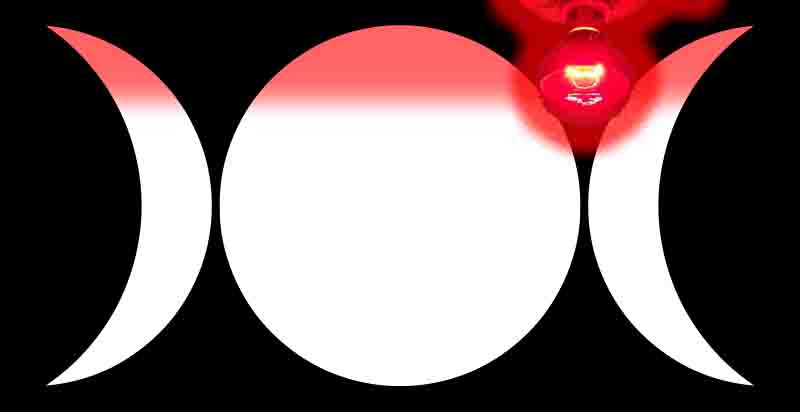
 ” and nowadays taken as gospel by modern neo-pagan groups. However, I have a problem with it – for the following reason. The “Triple Goddess” supposedly represents three ideals of womanhood, Maid, Mother and Crone, or to put it another way:
 : fortunately though, I have seen a copy dating from a Stella Matutina temple circa 1916, so I have been able to compare. Now this is a proper ritual. It has drama, it has beautiful ritualistic speeches, but most importantly it introduces in the course of the ritual several key qabalistic concepts which provide much food for thought. The ritual should be read in conjunction with the account of W B Yeats’ own experience of this ceremony, which is printed in George Mills Harper’s
  , which gives details of the astral work that went on invisibly as the ceremony took place.
 . It catches Waite as he was beginning to embrace mysticism, yet had not completely thrown off all of the trappings of the original GD. Now here is a curious thing: despite superficial differences, much of the underlying structure of the first Waite ritual is identical to that of the Stella Matutina version. E.g. the aspirant remains in silence until released in the final part of the ceremony, he or she goes into the Vault for a period of meditation, before encountering the Shekinah, who leads the aspirant out. Intriguingly, Waite identifies the Shekinah as Nuit, and the newly advanced aspirant as Horus. Could this in fact mean that Waite was a secret Thelemite (extremely ironic given the caning he received from Crowley in the Equinox)? Or perhaps when Crowley received the Book of the Law, the Gods were telling him not to become the prophet of a new aeon, but that he was now ready to become an Adeptus Major?






 Sol Ascendans - The Website of Alex Sumner
What the stars have in store for The Sun On Sunday
Rupert Murdoch and his son James
The world was in mourning yesterday when Rupert Murdoch, to absolutely no-one’s surprise at all, confirmed that The Sun newspaper would be launching a Sunday edition. Vigilant web-observers had reported that the domain name had been registered the very day after the closure of the News of the World was announced last year. What is news however is that the date of the first issue has been confirmed as Sunday 26th February 2012.
I have therefore taken it upon myself to cast a horoscope for the paper, in order to see how Murdoch’s latest enterprise will fair. As the paper is based in London, and will be available from midnight onwards, I have taken 12am London, UK, on Sunday 26th February 2012 as the time, date and place for the chart.
Birth chart for The Sun on Sunday courtesy of Astrodienst.com
The genesis of the idea
Rupert Murdoch probably decided the launch date for the Sun on Sunday two weeks previously (12th February) – which just so happened to be the date the Sun announced that he was due to fly into London (Moon is two degrees past Venus in a Cardinal sign and a succedent house). No surprises that it comes about as a direct result of the trials he has been going through recently (Moon opposite Saturn). That the Moon is in the fifth house AND in conjunction with Venus indicates that Murdoch was probably being over-dramatic in doing so, acting from romantic notions about what should become of the new paper.
“Birth-chart data”
The paper has Sun-Pisces and Scorpio-Ascendant. The latter indicates that the face the paper presents to the public will be overly concerned with both Sex and Death, whilst the former indicates that its attempts at factual reportage will be marked by flights of fantasy, wishful thinking, and a tendency to adopt a dreamy view of the world as opposed to one which is strictly accurate. The fantasy / wishful thinking aspect will also be evident through its writing style, and the editorial will be forthright in putting forward the paper’s “beliefs” (Mercury in Pisces).
The paper’s sun sign, being on the IC, indicates that its primary focus will be to establish a safe and solid house style which will see it through the long-term. Given that its sun- and mercury- are both trine to the ascendant, this indicates that the paper will be successful in integrating its fantasy / wishful thinking style with its Sex / Death subject-matter.
Prospects for the future
The paper will generally do well at least for the first twenty-one months of its existence, but will face a severe crisis in November 2013, which is when Saturn transits the paper’s ascendant. The edition of Sunday November 24th 2013 will be a time of particular difficulty for the paper. The paper will be forced to face up to its responsibilities and adopt a serious tone – a significant number of staff will be forced to leave as the paper tries to slim down. This does not necessarily entail fatal consequences for the paper, as it will be able to put across its position to the general public very well (Mercury is transitting the paper’s ascendant at the same time).
Conclusion
The stars are all lining up to suggest that the new Sun on Sunday will conform to everyone’s prejudices of how it is likely to turn out!!! Generally speaking I predict that if the paper can survive the crisis in November 2013 it will mostly do well. The circumstances of its birth – i.e. the memory of the closure of the News of the World and how its journalists were treated by Murdoch – and are being treated by the Leveson Inquiry at the moment – will affect the general atmosphere in the news room for a long time.
Leave a comment
Filed under Comment, Supernatural
Tagged as astrology, Mystic Meg, News International, News of the World, Rupert Murdoch, The Sun On Sunday