
It’s that time of year again when we celebrate World Tarot Day! And by “we” I mean Tarot readers as I wasn’t aware that anyone outside Tarotdom actually knows about this international holiday. Anywho, I look on my shelf to see how many decks I have and I realise that I have acquired five new ones since this time last year.
One of those was the deck I created for myself, which I have described in previous blog-posts, and which I now use as my default deck when I am at home.
The other four, however, are commercially available decks, so I shall review them here. Incidentally, by coincidence these all came from Watkins Bookshop, which is the best place for buying tarot decks in London, and which I have previously argued is the model for Flourish & Blotts in the Harry Potter books.
The Hermetic Tarot

The Hermetic Tarot – created by Godfrey Dowson, published by US Games Systems Inc
This is a Golden Dawn tarot, or rather “Stella Matutina” – a true Golden Dawn tarot, which is authentic in its depiction of the trumps, is yet to be published. The artwork is black & white line drawings. Given that the Golden Dawn was renowned for its sophisticated use of shades and hues, this might at first appear ironic, although I wonder if the whole point is that it is meant to be like the BOTA deck – to colour-in as one learns the King-, Queen-, Prince- and Princess- scales?
Nevertheless, I would say that the Hermetic Tarot is the favourite GD deck which I have in my possession – ranking ahead of the Robert Wang version. What I found helpful was that Godfrey Dowson included not only the proper titles of the cards from “Book T,” which aids enormously in card memorisation, but also the full astrological and elemental symbolism, as well as divine and angelic names where appropriate. Clearly a deck for use not just in divination, but in GD style magical-theurgical operations as well.
Morgan Greer Tarot

The Morgan Greer Tarot (English Edition), created by Lloyd Morgan and Bill F Greer, published by US Games Systems Inc
What strikes me first and most importantly about this deck is the artwork. This is clearly based on the Rider-Waite deck: however, unlike so many Rider-Waite clones the artist has gone and created new versions of all seventy-eight cards. The result therefore is bright and colourful (apparently the artist owes some inspiration to Paul Foster Case in this regard). Also, the cards dispense with a border so the illustrations go right up to the edge, making the cards seem bigger than they are.
Given its visual-appeal, this is a deck which I like to turn to when giving tarot readings for other people.
The Steampunk Tarot:
Wisdom from the Gods of the Machine

The Steampunk Tarot, created by John & Caitlin Matthews, illustrated by Wil Kinghan, published by Tuttle Publishing.
NB: This is not to be confused with the similarly named Steampunk Tarot, which is a different deck and published by Llewellyn. This one however is created by British writers and artists. Not that I am saying that this makes it inherently superior – but it is inherently superior 🙂
This is a rather ambitious project, in that not only is the deck a major accomplishment in itself, but the accompanying “little white booklet” is neither little (160 pages) nor, being fully illustrated, is it particularly white. The milieu of the deck is another universe entirely, where Steampunk is the prevailing world view: and in order to fully get to grips with this tarot deck, one almost has to mentally enter that universe as well! Fortunately, it turns out there is a direct translation to their analogues in conventional tarot.
Thus the suits are Airships (Swords); Engines (Wands); Submersibles (Cups); and Leviathans (Pentacles) – by analogy with the elements. The court cards are Captain (King); Lady (Queen); Navigator (Prince); and Messenger (Princess). The Trumps meanwhile have fantastic names such as “Technomancer,” “Cyborg” and “Regeneration Machine”: although it is clear from closely examining the corresponding descriptions that they have the same basic meaning as their regular counterparts (the cards mentioned are The Magician, The Devil and Judgement respectively). One unusual feature of the book is that the authors have created a mini-spread for each trump, as well as four general spreads (“blueprints”).
There is also an ongoing conceit that the universe is entirely mechanistic – in the sense of technology from late 19th century science fiction. Most notable however are the cards themselves. The artist has re-imagined an entire 78 card deck whose visual cues are entirely divorced from conventional decks, and has done an amazing job in doing so.
The Transparent Tarot

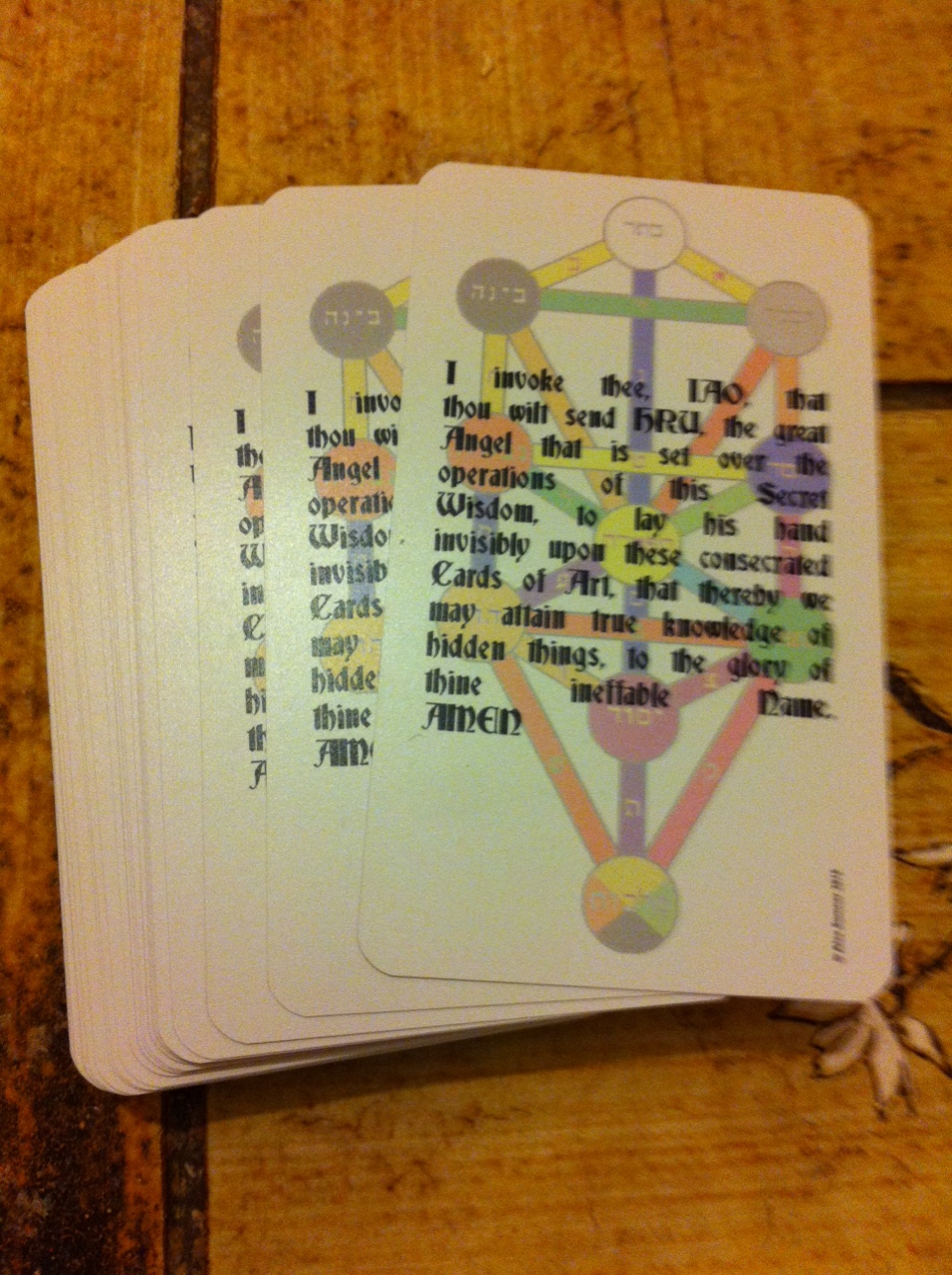
The Transparent Tarot, created by Emily Carding, published by Schiffer Publishing
NB: this is not to be confused with the similarly named Universal Transparent Tarot which is a different deck and published by Lo Scarabeo. The creator of this deck, Emily Carding, however is British, and not that I saying that this makes it inherently superior …
Seriously though: what both decks have in common is that the cards are printed on transparent plastic, such that superimposing two or more cards upon one another can generate new layers of meaning. What sets Ms Carding’s deck apart, however, is that her tarot features completely original artwork: whereas the Lo Scarabeo version is a ham-fisted derivative of the Rider-Waite.
Thus, although Ms Carding keeps each card in itself to a minimalist aesthetic, the act of combining the cards produces a thankfully uncluttered composite. The very nature of the cards necessarily invites the reader to delve into a more personal interpretation of the symbolism.
The deck also comes with a 280 page book (again no LWB!), as well as a handy white tarot cloth (essential really, in order to show the artwork of the cards off to maximum advantage).










 Sol Ascendans - The Website of Alex Sumner
General Election 2015: The Aftermath
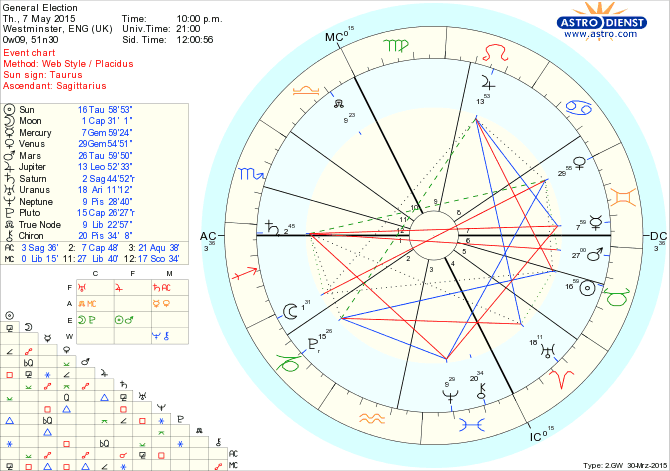
With the results declared, the British General Election is over, and so it is time to see how my predictions fared against the actual facts and figures. I cannot help but think that the overall conclusion to be drawn is that the stars predicted the direction the result was going to go today – though not the precise details.
David Cameron / The Conservative Party
What I wrote:
What actually happened:
The Conservatives did get an absolute majority – but only just, to wit: twelve seats. However, in practical terms it’s actually sixteen seats because Sinn Fein boycott the House of Commons on principle. The prediction I made did seem to reflect the BBC’s exit poll published just as the polls closed, but not the final results! Still, we should remember that it is entirely possible that with by-elections, this majority may be wiped out and become a minority in the course of this parliament – that is exactly what happened to John Major in 1992.
Ed Milliband / The Labour Party
What I wrote:
What actually happened
Labour were the second largest, and did experience a loss of seats to the SNP. However, due to a quirk in the UK’s election system, they lost a lot of seats not to UKIP, but because of UKIP. More about this anon.
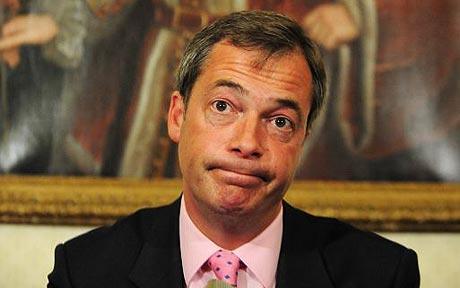
Nigel Farage / UKIP
What I wrote:
What actually happened:
UKIP saw significant gains in their number of votes, not seats. According to a BBC poll, UKIP notched up 12.6% of the popular vote, becoming the third most popular party amongst the electorate, with only the Conservatives and Labour in front of them. However, because of the way UKIP voters are distributed throughout Britain, voting for UKIP divided support for the Labour party, allowing in many cases the Conservative candidate to get in. Had for instance, the same number of UKIP voters been concentrated in a small region instead of equally distributed across the country, the same number of votes would have translated into increased seats in parliament – but the constituency map is gerrymandered against them.
Still I was right about UKIP having to jettison the more extreme elements of their party – e.g. Nigel Farage himself! 😛
Scottish National Party
What I wrote:
What actually happened:
The stars were generally correct about the SNP’s fortunes – also vindicating my decision to examine the horoscope of Angus Robertson, their campaign director. The SNP did see a significant gain in the number of its seats – mainly because, unlike UKIP, they are concentrated in one (demographically) small region (i.e. Scotland), where the average size of each constituency in terms of voters is smaller than the rest of the country. The system, in other words, is gerrymandered in their favour.
The SNP also failed to hold the balance of power, though for different reasons entirely – i.e. the Conservatives winning an outright majority. However: as I said above, it is still within the realm of possibility that the Tory majority may diminish within the lifetime of the parliament, so the dynamic of power between the parties may yet change.
Natalie Bennett / The Green Party
What I wrote:
What actually happened:
Unfortunately, this is precisely what occurred. The Green Party held on to its one seat in Brighton, but won nothing else.
Nick Clegg / The Liberal Democrats
What I wrote:
What actually happened:
I so totally called this one!!!
Leave a comment
Filed under Comment, Supernatural
Tagged as Angus Robertson, astrology, Conservatives, David Cameron, Ed Milliband, General Election, Green Party, Labour, Liberal Democrats, Natalie Bennett, Nick Clegg, Nigel Farage, SNP, UKIP