
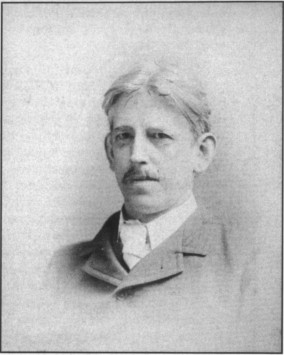
S L Macgregor Mathers
Mathers’ corollary to “The Chromatic Method”
Following on from yesterday’s post, I would like to review a similar method which Macgregor Mathers gave to the Alpha et Omega – it is set out in full detail in Pat Zalewski’s book Inner Order Teachings of the Golden Dawn
Like Case and Bennett, Mathers made an association with colours and musical notes – however he differs in several important aspects. Firstly, Mathers starts with the assumption that Red = F, not C as in the Case / Bennett system. Secondly: there are no sharps or flats in Mathers’ system. Thirdly, the Seven planets follow a scale starting with the F above middle C, and ascending in the same order as the walls of the Vault of the Adepti. Hence:
| Hebrew Letter | Colour | Note | ||
|---|---|---|---|---|
| Heh | Pe | Shin | Red | F |
| Vau | Red-Orange | F or G | ||
| Zayin | Resh | Orange | G | |
| Cheth | Amber | G or A | ||
| Teth | Beth | Aleph | Yellow | A |
| Yod | Yellow-Green | A or B | ||
| Lamed | Daleth | Green | B | |
| Nun | Green-Blue | B or C | ||
| Samekh | Gimel | Mem | Blue | C |
| Aayin | Tau | Indigo | D | |
| Tzaddi | Kaph | Violet | E | |
| Qoph | Vermilion | E or F | ||
This system has its advantages – and disadvantages. From a musicological (read: “snobbish”) point of view, some of the reasons that Mathers gives for adopting the particular peculiarities of this system are suspect and inconsistent, and smack of “dumbing down.” The only reason I can see for starting with Red = F and treating the planets as he does is to make use of the spaces and lines of the Treble Clef. Perhaps if he was confident with leger lines we might have had a whole different secret teaching! It could, of course have been to allow Adepti to play the piano one-handed, the left-hand being left free to hold a ritual implement or something.
However, Mathers’ aversion to sharps and flats is something else. The reason Mathers gives for avoiding it touches upon a problem that musicians have had to deal with for thousands of years, namely Temperament. It is impossible to tune the twelve-note chromatic scale so that all intervals are “perfect” – therefore, historically, several different methods have been proposed including the Pythagorean, “Just Intonation” (like Pythagorean but with easier arithmetic), “Well Tempered” (made famous by Bach’s Das Wohltempierte Klavier), and “Equal Temperament,” amongst others. The upshot of this is that depending on which system of Temperament you are using, the actual tuning of some chromatic intervals might vary by as much as 10Hz – enough to create an out-of-tune “beating” sound, assuming two different instruments had been tempered differently.
How did the Secret Chiefs, from whom Mathers claimed to derive this teaching, resolve the problem of Temperament? Um, well, the unfortunate fact is that although they were willing to lay down minutiae on a whole host of other topics, they conveniently passed on this one: the simplest way for Mathers to resolve the situation was to avoid using sharps and flats.
Of course, on the other hand, Mathers might have interpreted “Quit the night and seek the day,” as meaning “avoid the black keys and play only the white keys.”
What we thus have from Mathers is therefore a reduction of the chromatic scale to the F-Lydian mode – ironic, as Mathers complained about using modes as well.
HOWEVER: the very fact that Mathers’ system is completely unsophisticated compared to the Case/Bennett system is in fact its greatest advantage – because it allows Hebrew words to be chanted in simple melodies. This in turn makes it highly conducive to teaching a temple full of initiates whose musical talent may well range from hardened rock-musicians reared on Frank Zappa and Led Zeppelin to, well, drummers. By way of example, I shall now attempt to re-score the Lesser Banishing Ritual of the Pentagram according to the note-values suggested by Mathers.
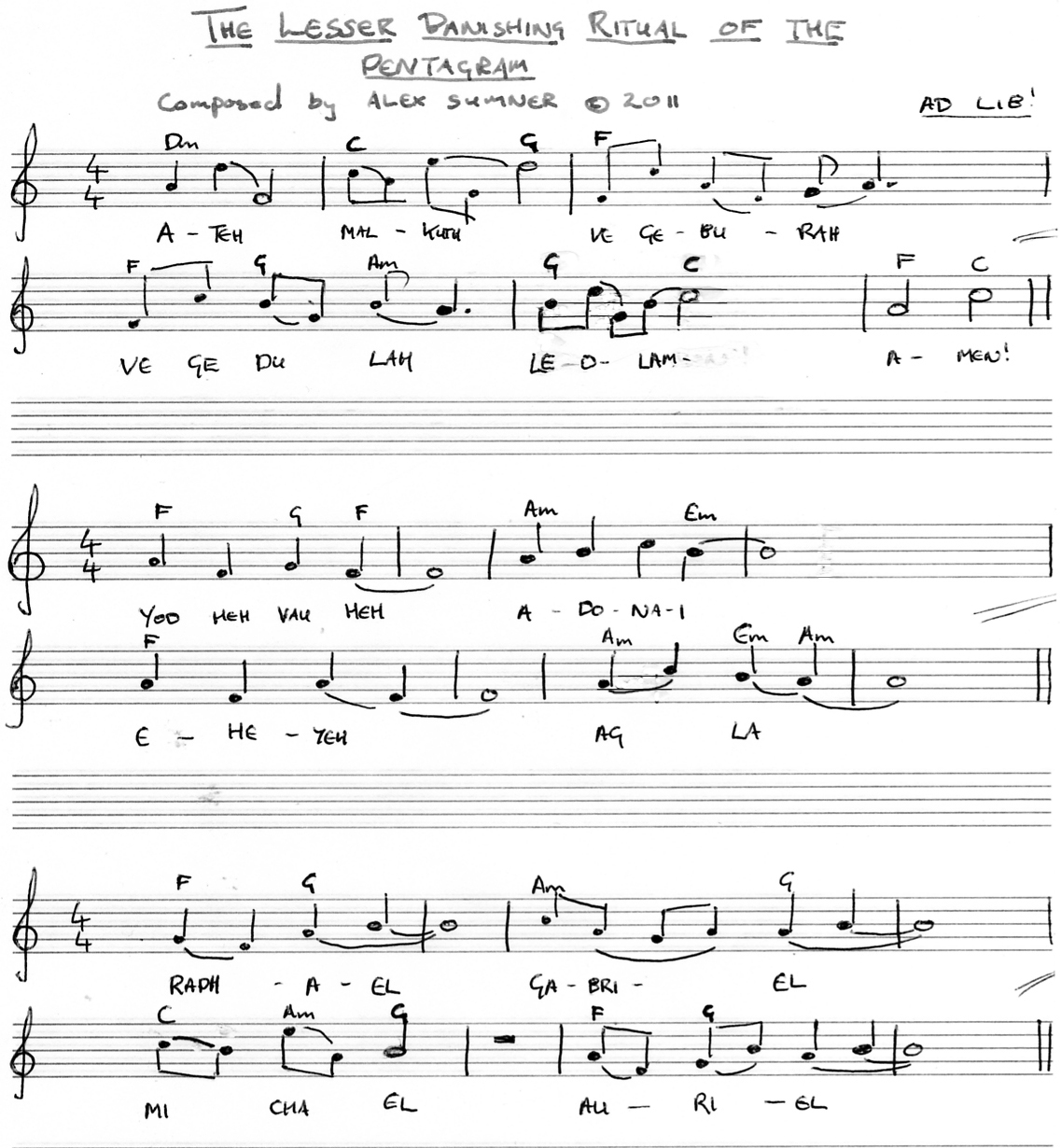
The Lesser Banishing Ritual of the Pentagram, composed by Alex Sumner © 2011.


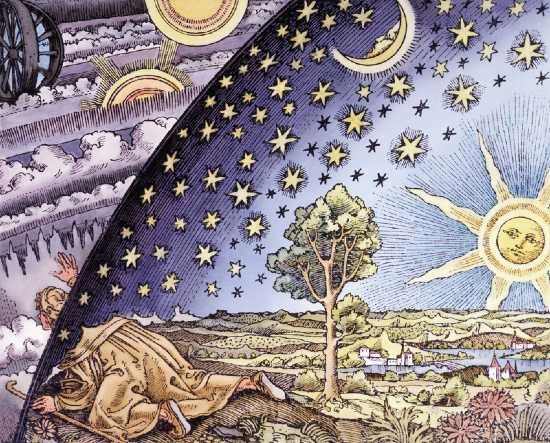
 by William Lilly (1602 – 1681). Wikipedia claims that Lilly was the last major practitioner of Horary Astrology. I can asssure you that although it is not so well known as Natal Astrology there are still some of us who practice it today!
 . The cards in the middle (2, 1, 3) represent the Here and Now. Those on the Right side (4, 8, 12; 7, 11, 15) represent what will happen if the Querent does not attempt to change his or her current course of action. Those on the Left ( 13, 9, 5; 14, 10, 6) however represent what will happen if he or she does attempt to change. Moreover the top-row represents the short-term future, whilst the bottom row represents the long-term future.
 by a chap called Mark Beynon, whom the Evening Standard describes as a “historian.” The Curse of Tutankhamun has been the subject of books before, but this new work focusses on some half a dozen deaths allegedly connected with it. Amongst those cited are:
 ).
). AND
AND 




 Sol Ascendans - The Website of Alex Sumner
Yale Scientists want to brainwash you into becoming mindless Zombies
“Inception becomes reality: People can teach themselves new skills in dreams” says the Daily Mail. Apparently researchers at Yale University have published a paper on the same in this week’s New Scientist.
Honestly: when I first read the article, I thought that the Daily Mail had raided my site for one of my old blog posts – but no, apparently, despite the fact that lucid dreamers like myself and others have been saying it for years, some scientists have now done experiments on it, which purportedly makes it official. The idea of being able to control ones dreams so as to stimulate ones learning sounds so plausible to me that I didn’t really give it much of a second thought. Until I saw the following throwaway remark – referring to Peter Morgan, the author of the paper:
I think not! Is it just me or does this remark sound incredibly dodgy? What the fuck is a person’s “social control” any business of Peter Morgan, Yale University, or anyone else’s for that matter? To “improve” a person’s social control you have to lay down a standard by which it can be judged. In other words, it entails imposing one’s own arbitrary values on someone else. And they intend to control someone’s dreams to do it!!! Never have I heard of such an intrusive idea! Oh wait, yes I have, as a matter of fact: Aldous Huxley first wrote about the same thing in Brave New World in 1932. Fuck me, these scientists ought to be ashamed of themselves.
1 Comment
Filed under Comment, Supernatural
Tagged as Aldous Huxley, Brave New World, Daily Mail, lucid dreaming, Peter Morgan, Yale University