Review: “Dr Dee,” London Coliseum, Saturday 7th July 2012
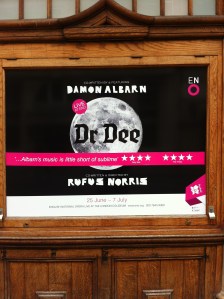
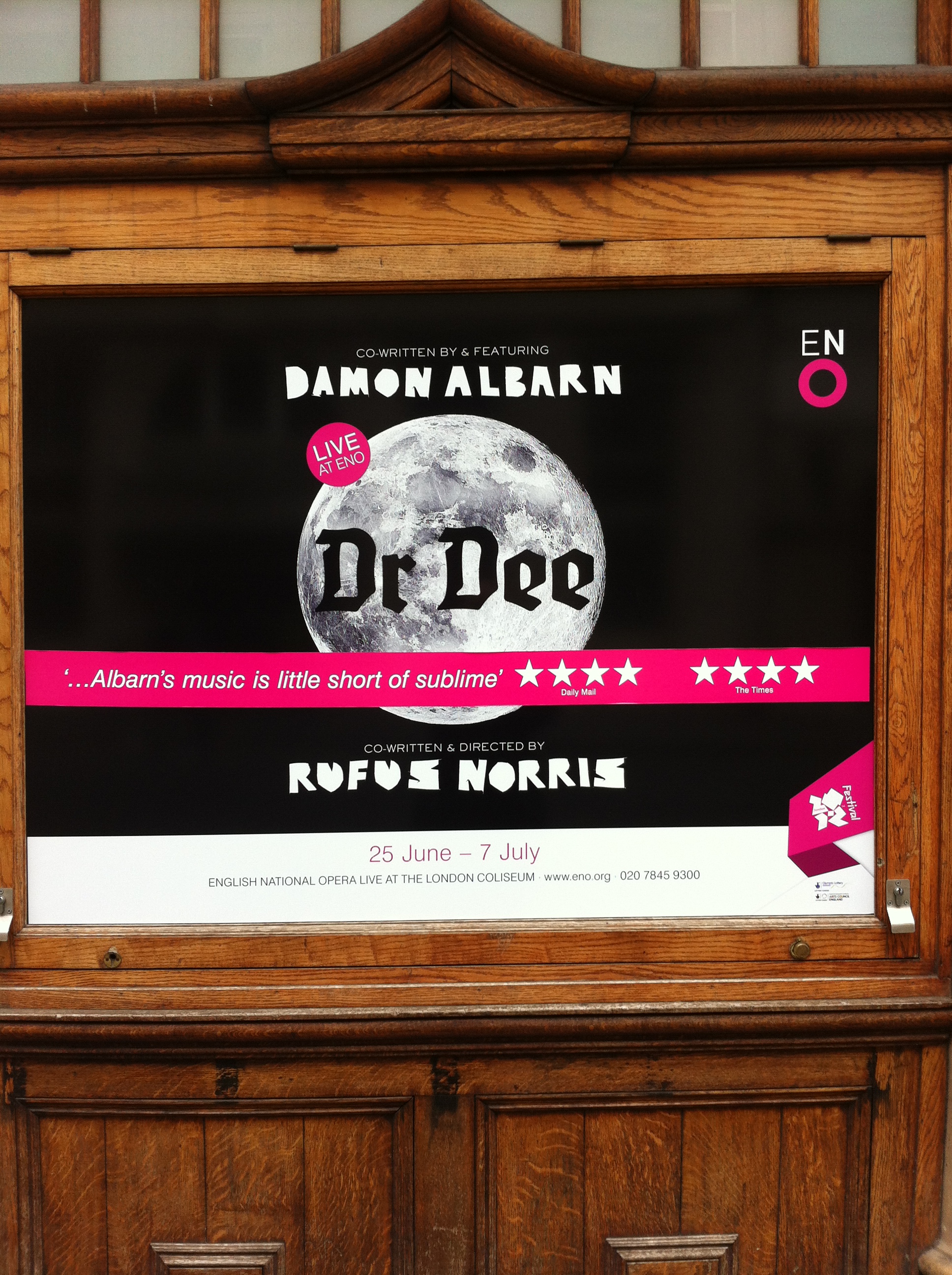
“Dr Dee,” the opera by Damon Albarn and Rufus Norris.
So there I was in London’s West End, weaving my way in and out of people wearing rainbow-coloured attire, en route to the English National Opera at the London Coliseum to see the matinée performance of “Doctor Dee.” Given that John Dee was such a pivotal figure in the Western Mystery Tradition – and remains so today – I found the idea of creating an opera about him curious. The idea that somebody famous like Damon Albarn would do so,and put it on in a major West End venue was even more curious, so I thought I’d better go investigate. Here then are my impressions of the event.
The venue was sold out. I scanned the audience, but I could not see anyone who looked obviously like an Enochian Magickian, except possibly a sinister couple dressed all in black. I was wearing a PELE ring all the time but nobody clocked it! No: instead I would estimate that the vast majority of the audience were there simply because they had been fans of Blur from back in the day – some were old enough now to bring their children with them. I did detect a sizeable number of “habitual opera goers” who appeared to be neither fans of Blur nor interested in the story of John Dee, but had just turned up because it was the pretentious thing to do.
Inside the auditorium, I immediately noticed that the outline of a large Sigillum Dei Aemeth had been marked on the stage. The lights darkened and a winged messenger announced the beginning of the performance: a raven flew down from “the gods” and alighted on stage, before obediently scampering off into the wings.

Dr Dee, by Damon Albarn
 There is an inevitable urge to compare the live performance with the soundtrack album which is currently available. In my opinion the former far surpasses the latter. Live, it is as much a work of dance, mime and even son et lumiere as it is of music. There are two sets of musicians: an orchestra hidden in the pit, whilst Damon Albarn and a group of musicians with Elizabethan instruments sit in a gantry which, during the performance, is raised above the stage. Rather than a “conventional” (read: old-fashioned) opera, it is staged in a deliberately expressionistic style in order to illustrate the story.
So for example the first appearance of Dee is as an old man on his deathbed, which is wheeled around stage by his daughter. The rest of the story is then told in flashback – although even as Dee is going about his adventures, the figure of the daughter pushing the deathbed is periodically seen in the shadows at the back of the stage, reminding us of his unfortunate destiny.
Dee’s rise as a man of learning is depicted in a dance sequence in which a dancer (disguised as the character) figuratively speed reads books which transform into endless streams of paper. Interestingly, the “endless streams of paper” later becomes the material which makes up the walls of the set in the various scenes – suggesting that Dee’s life was literally defined – or indeed limited – by his books and his obsession with learning.
The story though is a straightforward tragedy. Dee rises to prominence as a scholar and gets a rare chance to prove himself by casting an electional horoscope for the coronation of Queen Elizabeth I. The coronation is a success, and the new Elizabethan age buoys Dee’s fortunes – which include meeting and marrying his beautiful wife Jane. But Dee wants more – and into his life comes Edward Kelley (sung as a castrato, which is quite ironic given the Plot-Point in Act Two). With Kelley’s skrying Dee dares to aspire to the ultimate goal – not just human knowledge, but Divine Knowledge.
However, whilst Dee becomes obsessed with stealing this fire from heaven, he is ignorant Kelley staring long and lustily at his wife. Eventually tensions come to ahead. With his reputation under attack, Dee bullies Kelley into more skrying – at which point Kelley claims that the spirits are telling Dee to share Jane with him. Dee, who by now has had his vanity well and truly inflated by the spirit communications, cannot bring himself to admit that the same spirits who flattered him with the promise of Divine Knowledge before could be lying to him now (a classic case of Cognitive Dissonance!) agrees to let Kelley have his way with her. (Interestingly although Jane Dee was wearing a shift throughout, there was the merest hint of the Cup of Babalon visible at this point!) In short order Dee sees his life fall apart – his marriage ruined, his public reputation destroyed from accusations of “conjuring,” and he dies as an old and broken man.
Hence: Albarn places the blame for Dee’s ruin only partly on Kelley, but mainly on Dee himself. Dee’s lust for power – in the form of knowledge – obsessed him so much as to give him a towering ego. Kelley, whilst a rogue, was however merely motivated by natural inclinations of lust towards Jane, and resentment towards Dee.
In assessing a work like this, the question naturally arises: how much does Damon Albarn really know about the occult? In the press he has been evasive. When asked if he really believed in magic, he replied: “Cycling round London at 4am on a sunny morning – you don’t get more magical than that.” It is however obvious that he knows more than he is letting on. On the CD of the opera there is a cheeky sample of Aleister Crowley reciting an Enochian call (the sample is missing from the live performance). Even more tellingly, on the CD the first track is entitled “The Golden Dawn.” This incidentally was not played on Saturday when I went to see it, except very softly as the audience were taking their seats at the beginning.
More obviously though, many of the graphics that make up the Son et Lumiere are adapted from Dee’s magical manuscripts, for example the Tabula Bonorum Angelorum and the seals of the 91 Governors.
So one could say that Damon Albarn has used Enochian Magick to create a successful opera! Which is probably a more impressive feat than any Enochian magician has ever managed. Unfortunately, despite the fact that the current run has sold out, as indeed did the previous run in Manchester, this is unlikely to be one of those ongoing West End productions that will keep on going. The production is too heavily reliant on a unique set of performers, of which the most obvious example is Damon Albarn himself. It is hard to see the run being ever extended by changing the cast periodically, which is how most long-running West End hits sustain themselves. “Dr Dee” of necessity will only run for as long as Albarn commits himself to it. This is also why it could only transfer to e.g. Broadway if Albarn went to live in New York for sometime, which admittedly is theoretically possible. Hence, if I were given to prognosticate, we should expect to see a DVD of the performance being released sometime in the future.
51.509911
-0.126295



 ,
,  ,
,  . It also describes my own humble efforts with
  and its sequels (particularly in the character development of Nichola, the central character). Now it appears that there are an increasing number of emerging authors who specifically identify themselves under the “Visionary Fiction” banner. Let us hope that it is not too long before one of them (us) achieves major cross-over success!






 Sol Ascendans - The Website of Alex Sumner
What The Stars Have in Store for … Vladimir Putin
Vladimir Putin
What with three members of Pussy Riot being jailed in Russia, I thought it would be a good time to bring my powers of Astrology to bear on what will happen to Vladimir Putin, and guess what! His fate is writ in the heavens!
Background: Vladimir Putin
Putin, born 7th October 1952 in St Petersburg (or Leningrad as it was) has a Stellium i.e. a three-way conjunction prominently in his birth chart: Sun, Mercury and Saturn are all in Libra. This is actually a Quadrivium, if you include Neptune as well.
Unfortunately, right at this moment, both Saturn and Mars are in conjunction in Libra, which means that both these planets are transiting this Stellium – hence now is a time for major upsets in Putin’s life. So for example his second Saturn return – which marks the transition from maturity into old age – is taking place at a time when he is finding it a tough time to get his ideas across and present himself in a favourable light (Saturn – Mercury transit) which ironically is what is most important to him right now (Saturn – Sun transit). However, the influence of Mars transiting this Stellium means that he wants to battle every problem he comes up against. Although he’s facing all these difficulties, he wants to throw a lot of energy into solving them nonetheless.
Horary question: “What will happen to Vladimir Putin?”
This being the case, after having made a note of his transits, I went on to make a Horary divination, based upon the question “What will happen to Vladimir Putin?” The time, date and place for the question was today, 18th August 2012, 1048 British Summer Time (0948 GMT), Essex, UK. In the diagram below the stars and planets relating the Horary question itself are in the outer ring, whilst Putin’s natal chart is in the inner ring for comparison.
Outer ring (red): the stars for 18th August 2012
Inner ring (blue): Vladimir Putin’s natal chart (7th October 1952, St Petersburg)
The position of Luna (outer ring, in red) indicates the circumstances of the origin of the question. This is square to Jupiter, the planet of Rulers, suggesting that (surprise, surprise) the responsibilities of statesmanship have pushed Putin into his current troubles. This is in a succedent house and a mutable sign: and given that it is nine degrees past the Sun, this would indicate Putin’s current problems relate to something which happened just over nine years ago (29th – 30th March 2003). In other words, the Pussy Riot incident is only the most recent manifestation of a situation which has been many years in the making. Checking back on Wikipedia would suggest that the most important thing that Putin was involved in round about that time was the Chechnya situation: a new constitution was enacted in Chechnya on 22nd March 2003 by a pro-Moscow government which would give Chechnya limited autonomy whilst remaining most definitely under Russian (Putin’s) hegemony. However, before one says that Putin’s problems were caused by this or that, one should also note that Luna is opposed by Neptune, the planet of illusions, implying that the full details of Putin’s real predicament is being concealed from the public at large – and from the world’s media.
Putin himself is represented by the descendant, the Lord of which is Mars. As noted earlier, this is conjunct Saturn. I uncovered this quote regarding Saturn / Mars conjunctions:
If this does not describe Putin’s relation to the Presidency, nothing does! He stubbornly clings on to power because he is afraid to lose it, but ironically it will only be by retiring that Putin will achieve his full potential as a human being.
As regards the end of the matter, this is shown by the fourth house. In regards to the question itself, this is Capricorn whose ruler is Saturn, the planet of endings! Saturn has already been mentioned above, in regards to his transits: I would therefore predict that Putin is doomed to be permanently affected by his current problems – his negative public image, his worry about what other people think about him, his advance into old age – and is not going to recover from them. This being conjunct Mars suggests that the only possible solution is to retire gracefully, to avoid a personal calamity through stubbornly clinging on to power.
Alternatively one could argue that the fourth house in relation to Putin himself (who is represented by the descendant) is Cancer, ruled by the Moon, indicating that Putin is going to be continually harassed by the problems of statesmanship for as long as he choses to remain President.
Leave a comment
Filed under Comment
Tagged as astrology, Pussy Riot, Russia, Vladimir Putin