Tag Archives: Alchemy

Review: “Teaching System of the Golden and Rosy Cross,” by Bernard Beyer, translated by Ian H Gladwin

This is the first major book available in English which goes into detail about the “Golden and Rosy Cross,” the Masonic Rosicrucian Order deriving from Germany in the 18th century. I say “in English” because Bernard Beyer’s original text was first published in German back in 1925: it had remained untranslated – until now. But: who exactly were these Golden Rosicrucians?  

The Gold und Rosenkreuzer (to give them their original German name) emerged in mid‑18th‑century Germany as a secretive esoteric fraternity blending Rosicrucian mysticism, alchemy, and Freemasonry. Although the order formally coalesced in the 1750s, its ideological roots were older: members traced their lineage to the early Rosicrucian manifestos and especially to Samuel Richter’s 1710 alchemical work published under the name Sincerus Renatus, which outlined doctrines later absorbed into the order.

The group was shaped most decisively by Hermann Fictuld, a Freemason and alchemist who reorganized scattered Rosicrucian currents into a structured initiatory system. The order developed a nine‑grade hierarchy, emphasizing spiritual purification, laboratory alchemy, and the quest for the Philosopher’s Stone. Candidates were required to be Master Masons: although as the translator of this edition points out, this was more of a pious aspiration. The rationale of the first, “Junior” degree required that the candidate be conversant with the symbolism of Freemasonry, including the secrets of a Master Mason. However, after the first degree the Order left Freemasonry progressively farther behind. There was no requirement, for example, that one must remain a Mason after having joined, in contrast to certain modern Rosicrucian Societies.

By the 1770s–1780s, the Gold und Rosenkreuzer had spread across Central and Eastern Europe, establishing lodges in Berlin, Hamburg, Vienna, Prague, Poland, Hungary, and Russia. Their influence peaked when Friedrich Wilhelm II of Prussia, sympathetic to Rosicrucian ideals, elevated several members—such as Johann Christoph von Wöllner and Johann Rudolf von Bischoffwerder—to positions of political authority, allowing the order to shape religious and educational policy.

Rivalries with the Bavarian Illuminati, internal secrecy, and political upheavals after Friedrich Wilhelm II’s death in 1797 accelerated the order’s decline. By the early 19th century, the Gold und Rosenkreuzer had fragmented, though their ritual structure later inspired groups such as the Societas Rosicruciana in Anglia and the Hermetic Order of the Golden Dawn. However: there are rumours that despite the original order’s decline, it did not go completely extinct (e.g. Gustav Meyrinck was alleged to be an initiate), and that the last lineage holder only died as recently as the 1990s.

As regards this book in particular: a lot of this material has been summarised and quoted by commentators before (e.g. Arthur Edward Waite), but this is the first time that the primary sources have been made available to the reading public. So unless you are a Rosicrucian fan-boy who likes to spend their time poring over old manuscripts in the Library & Museum of Freemasonry, you will not have seen a lot of this material before.

Thanks to this current book, it is possible to compare and contrast the Golden and Rosy Cross with its nearest modern analogue, the Societas Rosicruciana In Anglia (SRIA). Both are societies purporting to be Rosicrucian and which require its candidates to be Master Masons. They have similar sounding grade structures:

GradeGolden & Rosy CrossSRIA
1st“Junior”“Zelator”
2nd“Theoreticus”“Theoricus”
3rd“Practicus”“Practicus”
4th“Philosophus”“Philosophus”
5th“Minor”“Adeptus Minor”
6th“Major”“Adeptus Major”
7th“Adeptus Exemptus”“Adeptus Exemptus”
8th“Magister”“Magister”
9th“Magus”“Magus”
10th(no tenth grade)“Adept of Christian Rosenkreutz”[1]

But that is pretty much where the similarities end. In the first grade of the G&RC the candidate is immediately confronted by an initiation ritual which is heavy with Alchemical symbolism. That of the SRIA is more hermetic or qabalistic. In the second grade, the G&RC members literally learn about the Theoretical basis of Alchemy in a teaching environment. In the third grade, Practici must participate in a practical Alchemical working, albeit as students at this stage. From the fourth grade onwards, the candidate, as a condition of advancement, must perform increasingly complex alchemical operations himself: whilst in the final grade – of which there is very little data given – the candidate is implied to undertake Divine Magic.

In contrast, in the SRIA each grade involves a certain amount of ritual drama, but there is very little in the way of practical teaching given. Far from learning and taking part in Alchemy, its members are encouraged to research and write papers on esoteric subjects. In fact, I have heard it said that in the old days one could not be advanced to the next SRIA grade unless one actually had presented such a paper to the Society: if that had been the case, it would at least have made the SRIA if not an Alchemical society, then at least as rigorous as continental Freemasonry. However, by the time I came into contact with it, this had completely fallen by the wayside, and members were routinely advanced to the next grade a year after attaining their previous grade, notwithstanding whether they had made any contribution or even attended at all within the intervening twelve-months.

The book ends by announcing that there will be sequel to this volume entitled “The Golden and Rosy Cross: Ritual, Revelation, and the Legacy of Rosicrucian Alchemy.” I heartily recommend both the current volume and its forthcoming companion to all those interested in this fascinating aspect of Rosicrucian history.

Beyer, B, Gladwin, I H (translator), 2025, “Teaching System of the Golden and Rosy Cross,” Pansophic Press, Dunstable, UK. ISBN 979 8 9993799 0 0


[1] This was not part of the original SRIA structure. It started off simply as a Medal given to senior members of the Society for outstanding service, until the last but one Supreme Magus decided to create a ritual for it.
Leave a comment

Filed under Supernatural

The Welsh Occult Conference 2025

Gregynog Hall

Today and for the next few days I will be releasing a series of blog posts inspired by my adventures at the Welsh Occult Conference, held on Saturday 17th May 2025 at Gregynog Hall, in Powys, Wales – just over the border from Shropshire.

In brief: I enjoyed it immensely, so much so that I would want to return in future, even if I am not one of the speakers as I was this year.

All credit must go to the organisers, Gary St Michael Nottingham and Leslie Jackson, whom both my fiancée and I would like to thank not just for inviting me to take part, but for their generosity and hospitality generally.

There were over a hundred people there, some from as far away as Canada and Malta. One lady even came up to me and told me she had come to the conference purely to hear me speak!

Gary himself talked about Israel Regardie and Alchemy, illustrating the kind of thing up to which Regardie would have got with examples from his own Alchemical practice.

Meanwhile, I spoke about Abramelin: whilst after lunch, Carrie Kirkpatrick spoke about her forthcoming film “World War Witches”; Elaine Bailey talked about Anna Bonus Kingsford; Anne Turner talked about her parents Robert and Patricia Turner, leading members of the Order of the Cubic Stone; and Geraldine Beskin talked about Annie Horniman.

Stephen Skinner in the end did not attend in person, but recorded a talk which was played to the conference. This really annoyed me, as I had brought all my Stephen Skinner books with me in the hope he would autograph them – only to get the message that he had taken ill after we had set out for Wales!

As well as friends whom I already knew well, I was fortunate to meet a number of Facebook Friends for the first time! As well as many others whom I rarely get to see in the flesh.

Finally I would like to thank my fiancée as well – especially as she did all the driving this weekend. I did offer, but for some reason she thought it would be safer if she was behind the wheel instead of me.

Leave a comment

Filed under Comment

What Is The Book Of Abramelin The Mage From Interview With The Vampire?

Here at Castle Sumner, no sooner have I come out with a book (nb: PLUG) in which I, ahem, dissect references to Abramelin in A Dark Song, than I find another reference to it in pop-culture, namely the newest adaptation of Anne Rice’s Interview With The Vampire.

In his article What Is The Book Of Abramelin The Mage From Interview With The Vampire? Mike Worby says:

When Lestat, Louis, and Claudia corral their victims from a Mardi Gras party into a room during the Season 1 finale where they purport to have hidden their secret, Lestat describes the fictional liquid as being the famed elixir of life which has oft been the goal of alchemists for hundreds of years. However, how he claims to have come into the knowledge of the concoction relates to a tome that he calls “The Book of Abramelin, the Mage.”

As it turns out in this often fantastical take on “Interview With the Vampire,” the book Lestat describes is based on a real piece of occult history. […]

Of course, as with any supposedly magical tome, we obviously can’t confirm or deny whether any of this actually works. Still, as the basis of a simple throwaway line in “Interview With the Vampire,” the writers must be lauded for doing their research and finding an appropriate real-life book to cite for their characters’ supposed magical knowledge — and even one that viewers in the real world can actually read today if they want to.

OK I’m going to skip over the fact that that scene was set in late 1790s America, when Abramelin was not available in English, and the only published edition extent was not called “The Book of Abramelin.” 😉

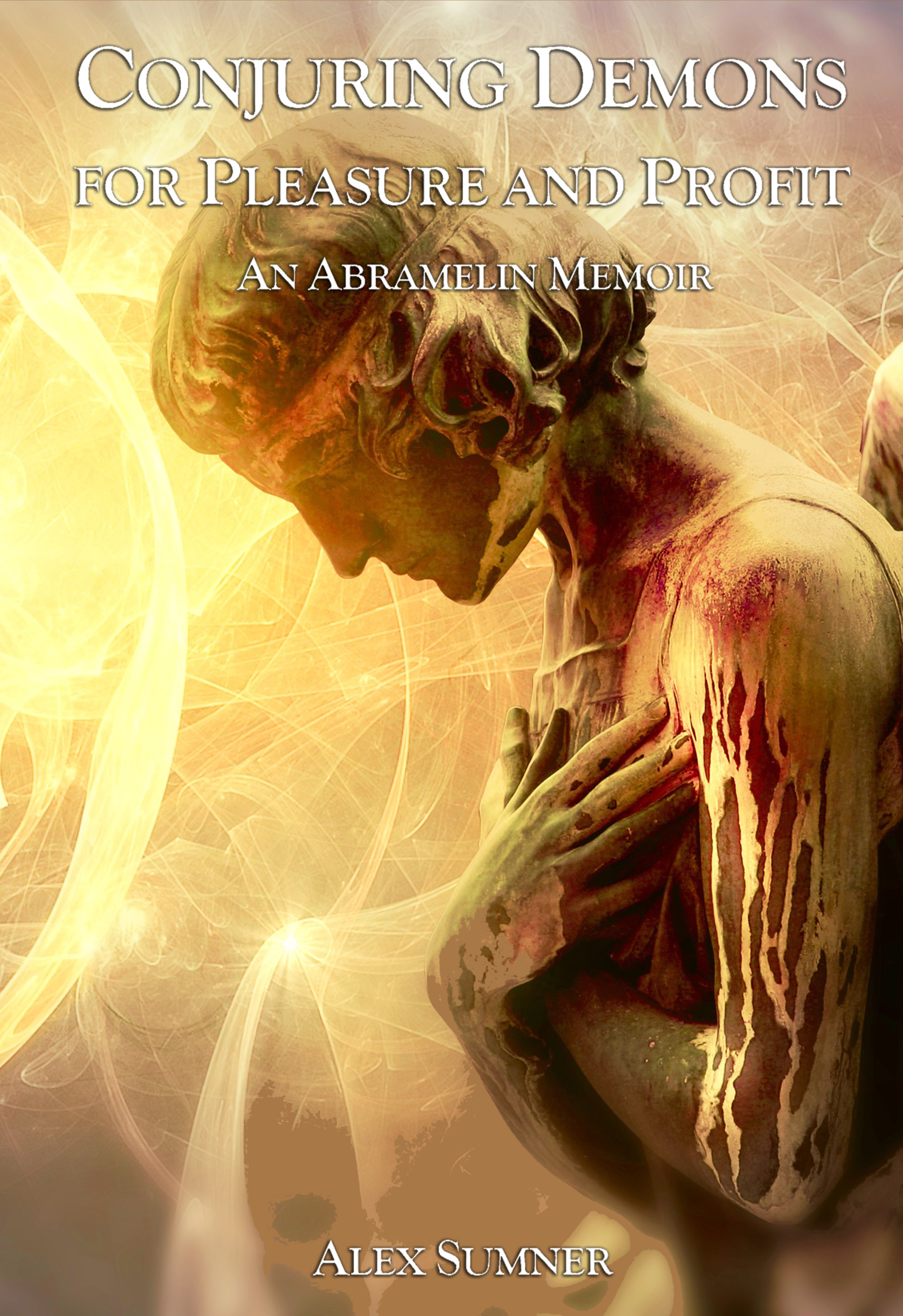
The question which naturally arises in the mind of an occultist is – could Abramelin be really used for Alchemical purposes? In my new book, Conjuring Demons for Pleasure and Profit, I argue that it can, and indeed I myself have attempted to do so.

My thoughts turned to Alchemy almost immediately after completing the Operation. In its immediate aftermath, I spent a lot of time researching the history of the concept of the “ Holy Guardian Angel,” in the course of which I also researched the etymology of a term bandied about by contemporary occultists, the Augoeides.

Crowley implicitly used this as a synonym for “ obtaining Knowledge and Conversation of the Holy Guardian Angel.” However, taken literally, the word Augoeides does not refer to an angel or dæmon at all – it means “ dawn-like image ” or “ shining body .” Hence, Augoeides should more properly refer to the Resurrection- or Solar-Body, which is the Philosophical Gold. Or to put it more simply, if one imagines Divine Union as a destination, the Augoeides becomes the car which takes one there, whilst the Holy Guardian Angel adopts the role of the driving instructor who teaches one how to drive it in the first place.

I thought : could I use Abramelin-magick itself to help me realise my Augoeides ? The Book describes the function of the third word square of part IV, chapter 7 as “ to learn all sorts of Alchemical arts from the spirits.” Perhaps this really meant Internal Alchemy ? If so, then in amongst all the word-squares which promised rather worldly, low-magick attainments, I had found one which could provide me with practical help as a Hermetic magician.

Sumner, A (2022) Conjuring Demons for Pleasure and Profit: an Abramelin memoir, Thoth Publications, Leicester, UK – p534

The significance of this is that some continental schools of Alchemy (e.g. Kremmerz et al) allege that it is the realisation of the Solar Body which provides the true key to immortality – by allowing one to exist in a perfected form, free from the ravages endemic to imperfect matter. Or in other words, the Elixir Vitae although not literal, is nevertheless a metaphor for a real Alchemical phenomenon.

To cut a long story short, I did a magical operation in which I deployed word square number three from Book IV, Chapter 7 of the Book of Abramelin, whilst researching all I could about Alchemy, and discovered a powerful method of meditation, similar to Kundalini Yoga, which synthesised the teachings of Sendivogius, Isaac Newton, Paracelsus – and of course, the Emerald Tablet of Hermes Trismegistos.

NB: I do not claim to have realised the Solar Body – I claim to aspire to do so. I’m still just a neophyte in that regard.

So in conclusion, to answer Mr Worby, yes, in my opinion it is both plausible and possible. In fact I shall probably make a note to watch this new adaptation when it becomes available on Netflix.


Conjuring Demons for Pleasure and Profit: an Abramelin Memoir by Alex Sumner is out now in paperback.

Leave a comment

Filed under Books, Conjuring Demons for Pleasure and Profit

Abramelin Adventures: Alchemy

I P O M A N O
P A M E R A M
O N A L O M I
M E L A C A H
A R O R A M I
N A M A L O N
O M I H I N I

The third word square of Book IV, chapter 7 of the Book of Abramelin (Dehn), “To learn all sorts of alchemical arts from the spirits.”
Note that I have altered the sixth line from that given in Dehn, as explained below.

This post follows on thematically from Abramelin Musings: Square Dancing, which I wrote back in June, or as I call it, Day 53. In the previous post I suggested a method of how to verify the correct lettering of any given word-square, by skrying into it – an idea inspired by Aleister Crowley. I therefore decided to put my money where my mouth was, by actually trying this out myself, selecting the third square of chapter 7, book IV of the Book of Abramelin.

Chapter 7 is entitled “To have the spirits make alchemy work,” whilst the third word-square is described as “to learn all sorts of alchemical arts from the spirits.” The word-squares of this chapter are given by the Holy Guardian Angel and are under the presidency of Ashtoreth and Asmodi – it is also said that the works of this chapter can also be carried out by the serving spirits. I did not choose this word square arbitrarily or at random, neither did I do it out of curiosity. Instead I had an eye to my long-term magical career, thinking that improved knowledge of Alchemy could only be a good thing – it is the Great Work, after all!

Dehn gives this as IPOMANO, PAMERAM, ONALOMI, MELACAH, ARORAMI, NANAMON, OMIHINI.  Now it so happens that on the third day of Convoking the Dæmons – the day on which one conjures them specifically to empower the word-squares of “signs” as to which they are referred – it is implied that the signs may contain the name(s) of the spirits which rule them. “Aha!” I thought. “Surely if this square contains the name of a spirit, it would be one of those listed as being the servants of Ashtoreth and Asmodi?” However, consulting this list drew a blank – at least at first. However, I did notice that one of the spirits named was NAMALON – the upshot of my attempts at clairvoyance suggested that this should replace the sixth line of the word square (see the results at the top of this page).

Why however should the Royal Art be in the province of Demons at all? Why should such a noble science as Alchemy be associated with black magic? The answer, I believe, lies in achieving a full understanding of what’s going on with the Abramelin process. Attaining Knowledge & Conversation of the Holy Guardian Angel is all about sublimating supposedly evil forces to a good end. Thus the true Adept, having integrated the Demonic powers with his Holy Guardian Angel, sees Alchemy’s full spiritual potential as a means of attaining the loftiest goals of Hermeticism (and conversely: a true Alchemist who is firmly committed to the spiritual path is undoubtedly being led by angelic forces). The “puffer” however, meets the Demon of Alchemy without it being conjured to play nicely with one’s HGA, with the result that he misses its spiritual side and is seduced by the lure of materialism, seeking after ordinary gold instead of its Philosophical equivalent.

I hesitate to be dogmatic about my findings, and would encourage others not to take my word for it and investigate the word-squares to verify them for themselves. As to whether I myself have discovered all the secrets of Alchemy through this process – well I certainly can’t claim to have completed the great work by any means, although I do think the experience helped my understanding of internal alchemy, showing me how it fits in nicely with the writings of Sendivogius, Kirchweger, Paracelsus and, of course, the Emerald Tablet. Whether I am on the right track or not will be the subject of a future blog post, if I am still incarnated in a physical body by that time.


Thanks to my Holy Guardian Angel, my familiar spirits, Ashtoreth, Asmodeus and the spirit Namalon.

3 Comments

Filed under Supernatural

Review: The Hermetic Science of Transmutation, by Giuliano Kremmerz

Giuliano Kremmerz (born Ciro Formisano, 1861; died (at least physically) 1930) was one of the most influential Italian Occultists of the late 19th and early 20th centuries. His writings have been translated into French and Spanish, but he remained largely unknown amongst Anglophone magicians as they were never translated into English – until now.

Giuliano Kremmerz, 1861 – 1930

“The Hermetic Science of Transformation: The Initiatic Path of Natural & Divine Magic,” was first written by Kremmerz in 1896, apparently in the hope that acquainting Italian readers with the power of the occult would lead to a new Renaissance of the mind. His reaction to the events of the subsequent twenty years betrays his bitterness that this did not happen. Anywho, the main points that Kremmerz makes, as I understand them, may be summarized thus:

  • The goal of the Magician is to Transform oneself into a God. But this is not the “become a living god” rhetoric that has blighted the credibility of modern occultism, for Kremmerz also stresses that the first duty of a magician after acquiring god-like power is to use it for the good of humanity in general, or one’s neighbour in particular.
  • Likewise, Kremmerz stresses continually that only Magicians who are pure in heart and intention can participate in the Divine Magic. Kremmerz’ morality is thus almost Christian in outlook, and he himself professes great admiration for the figure of Christ. But not so much for the Church, which he criticises for having lost the keys to magic, whilst yet clinging to meaningless dogma.
  • The key to this apotheosing is the Transmutation of the Sexual Force. However, far from entailing wild and reckless orgies, this actually entails careful conservation of the sex-force – even to the point where Kremmerz says that only absolute chastity can enable a participation in the Divine Magic. This results in Kremmerz’ sexual alchemy coming across as prudish compared to the smut of later authors such as Crowley, etc.
  • A consequence of actively attempting to make of oneself a God is that the Magician acquires the ability to perform works of Thaumaturgy.

Now that we have an actual work of Kremmerz in our hands, it is interesting to compare it with some of the lurid, and quite frankly disgusting, writings attributed to him which have been circulating on the internet and other places for several years (mostly in Italian), referred to variously as the Dossier Segreti or Corpus Totius Magiae.

In this “Hermetic Science…” book, Kremmerz speaks of his Myriam Fraternity, the aim of which is to perform works of Healing and purification.

Kremmerz does not however mention or even hint at the existence of the “Egyptian Order of Osiris,” which is the subject of the purported Corpus Totius Magiae.

I am reliably informed – by several different people – that the Corpus Totius Magiae is a hoax insofar as it claims to represent Kremmerz’ practices.[1] The present book, “Hermetic Science…” does however give an accurate flavour of the philosophy underpinning the Myriam work, without obviously giving away any of its secret rituals. Reading it myself, the difference in tone between “Hermetic Science…” and the Corpus Totius Magiae becomes one of sharp relief – as if no-one could believe they belong to the same organisation without epitomising the essence of DoubleThink. And yet, the most widely cited academic source, Hans Thomas Hakl in Hidden Eros,[2] seems to conflate Kremmerz’ own writings with the contents of the Corpus Totius Magiae uncritically.

(As an aside, it is within my personal knowledge that at least one Big-Name-Occultist has been duped by some passing salesman of magical charters into buying the Corpus Totius Magiae as The Ultimate Secrets of Magic. What bewildered me was not that he necessarily believed this to be the case, but that he paid good money for a document that had been floating around for free for several years on the internet. The moral of the story is – first learn to speak Italian, before buying something written in Italian).

In short, I would recommend this book purely on the basis that it forms a key link in our understanding the History of continental Occultism, and I look forward to more works by Kremmerz becoming available in English in the future.


Notes

[1] Whether or not the practices described therein are genuine at all, however, is another matter entirely.

[2] Hakl H T, Hanegraaf W J (ed.), Kripal JJ (ed.), 2008, “The Theory and Practice of Sexual Magic, Exemplified byFour Magical Groups in the Early Twentieth Century,” from “Hidden Intercourse: Eros and Sexuality in the History of Western Esotericism,” Brill, Leiden / Boston.

2 Comments

Filed under Uncategorized

The Esoteric Significance of Notre Dame Cathedral

Who is left among you that saw this house in her first glory? and how do ye see it now? is it not in your eyes in comparison of it as nothing?


Despite the terrible news from Paris, the conflagration that befell Notre Dame has now been extinguished and, while the roof and historic spire have collapsed, most of the stonework including the historic towers is still intact. This is highly important, from an esoteric point of view.

Notre-Dame Cathedral.
“The 850-year-old Gothic building’s spire and roof have collapsed but the main structure, including the two bell towers, has been saved, officials say.”
(BBC News)

Although the world has been experiencing a collective panic about the art-work inside the Cathedral, there is still an enormous amount of art built into the fabric of the building itself. Take for example the North and South towers (see above). Note how they resemble two great pillars standing at the entrance? They represent Boaz and Jachin, the two great pillars which stood at the entrance to King Solomon’s Temple.

Internal floor plane of Notre-Dame Cathedral

Internal floor plane of Notre-Dame Cathedral

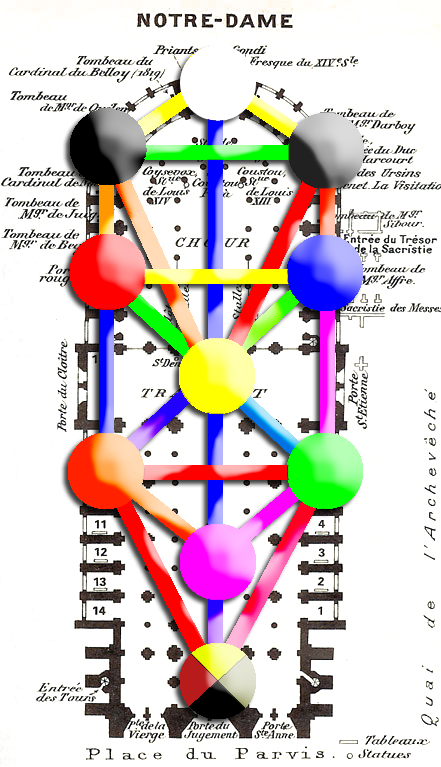
The ground plan of the interior follows a cruciform design, as is common in Christian churches. Moreover it is possible to overlay the Qabalistic Tree of Life over the design as well, such that the high altar represents the Supernal Triad; the Choir to Chesed and Geburah; the Transept to Tiphereth; the Nave to Netzach, Hod and Yesod; and the entrance to Malkuth.

… with Tree of Life superimposed.

Whilst the Tree of Life may be a latter interpolation, there can be little serious doubt that the masons who worked on the original structure did observe the principles of Sacred Architecture, in trying to incorporate the symbolism of both the Old and New Testament into the Cathedral – hence indicating the mysteries upon which Freemasonry is based.

The Mystery of the Cathedrals, by Fulcanelli

The best exposition of sacred architecture in regards to Gothic Cathedrals in general, and Notre Dame in particular, remains that of Fulcanelli. He introduces his theme by stating:

Above all there is nothing more captivating than the symbolism of the ancient alchemists, so ably translated by these modest medieval statues. In this connection Notre Dame of Paris, the Philosophers’ church, is indisputably one of the most perfect specimens and, as Victor Hugo said, “the most satisfying summary of the Hermetic science, of which the church of Saint-Jacques-la-Boucherie was such a complete hieroglyph.”

Mediaeval Alchemists would use Notre-Dame as a meeting place. Moreover, the design in inherently alchemical: its cruciform manner points out that the “Sign of the Cross” represents the preparation of the Stone (cf: the Transept – which “crosses” the Cathedral – effectively refers to the Gold of Tiphereth). The Rose window above the western door represents the wheel of time – the time necessary to concoct the stone. Moreover the main west door – the “Porte Du Jugement” – is elaborately decorated – superficially to represent the last Judgement, but on closer examination contains a plethora of Hermetic symbolism.

The Porte Du Jugement

Fulcanelli also points out Hermetic symbolism to be found elsewhere on the Cathedral’s exterior (e.g. the “Porte de Saint-Anne” to the right of the “Port de Jugement”). Curiously, the vast majority of the Alchemical symbolism is on the outside of the Cathedral, at the entrances: perhaps signifying that Alchemy is ultimately about purifying oneself, so that one is then worthy enough to enter into the Holy of Holies.

It is gratifying that within 24 hours of the incident millions of Euros have already been pledge to aid its restoration, as the sooner the building again becomes fit for worshippers – both exoteric and esoteric, the better.


The glory of this latter house shall be greater than of the former, saith the Lord of hosts: and in this place will I give peace, saith the Lord of hosts.

2 Comments

Filed under Comment

What is your source of occult information? – Quora

Alex at home, studying.

(A2A) Donald Michael Kraig’s “Modern Magick” was my first serious book on practical occultism as well. It is an ideal book for beginners because (a) it contains a lot of suitable material to get you started; and more importantly (b) it also has an extensive bibliography which will clue you in as to where to go and what to read to pursue your studies further.

Other books I generally recommend:

(For beginners):

(More advanced):

(Even more advanced):

The Greek Magical Papyri In Translation” (H D Betz), “Transcendental Magic – its Dogma and Ritual” (Eliphas Levi), “Light on Yoga” (BKS Iyengar), other books by Dion Fortune, Israel Regardie, Crowley, S L MacGregor Mathers, primary texts on Adam McLean’s Alchemy website / Joseph H Peterson’s website, etc, etc, etc.


Source: Alex Sumner’s answer to What is your source of occult information? – Quora

3 Comments

Filed under Supernatural

Alex Sumner’s answer to As someone interested in Alchemy, would you recommend any book? Why would you propose those book in particular? What did they taught you? – Quora

For a beginner, I would recommend “The Alchemist’s Handbook” by Frater Albertus. Although the spagyric work it describes is only introductory, it does do a good job of acquainting the student with the basic terminology.

Also, one should read up on Hermeticism. Freke & Gandy’s “The Hermetica” is an introduction, although I prefer GRS Mead’s edition of “Corpus Hermeticum.”

Splendor Solis

After one has read these, one is then ready to move on to the more advance stuff such as:
– all of which I would also recommend.

Source: Alex Sumner’s answer to As someone interested in Alchemy, would you recommend any book? Why would you propose those book in particular? What did they taught you? – Quora

Leave a comment

Filed under Supernatural

Alchemy and Reincarnation

Cover of 'Horror at Fontenay' by Alexandre Dumas, part of the The Dennis Wheatley Library of the Occult

Insert joke about cutting off the Caput Mortuum here…

In 1849, Alexandre Dumas père, he of ‘The Three Musketeers’ renown, came out with one of his lesser known works, ‘A Thousand and One Phantoms,’ at least part of which is now published in English as a slim volume entitled ‘Horror at Fontenay.‘ The original title hints at the nature of the work, in that it is a series of short stories, but unlike the Arabian Nights they are mostly macabre stories, skirting around the supernatural, focussing on Death. One gets the impression that in the same way that H P Lovecraft used his own horror stories to work through his dread – and survivor’s guilt – over World War I, Dumas is here using this collection to work through his own feelings as regards the Reign of Terror, which happened almost sixty years previously (or forty years before the story-collection is set).

Anywho, that is by-the-by. This slim volume had lain untouched on my bookshelf for some time, after I purchased it as part of a job-lot some years ago, when I was drawn, as if by some Occult Hand (i.e. my own) to pick it up. What most interested me was that one of the characters in the book – acting as one Dumas’ participants in the Symposium of Death thus presented – was the real-life occultist Jean Alliette, better known as ‘Etteila’ of Tarot fame. Alliette, the character, prefaces his own macabre tale by remarking to a fellow story-teller:

“My dear Moulle,” he exclaimed, “I have considerable venerations for your opinions and appreciate your story. In fact I accept it at its face value. But you seem to overlook completely the very important point that life is not destroyed by death, which merely disintegrates the human body. The personality remains; and ultimately death destroys only memory, that is all! If memory were not effaced life could become very complicated – for we should all remember every onve of our past lives, right from the beginning of time to the present day. Which probably explains why we feel animosity or love, on sight, for people we don’t know. It’s really a kind of unconscious recognition…

“The Philosopher’s Stone is another name for the secret of this memory – a secret uncovered by Pythagoras, centuries ago, and recently rediscovered by Saint-Germain and Cagliostro – not to mention myself, for I also hold possession of the key. But I am an unusual case; for though my bodies may die, as they have already done several times, each one exists for a much longer period that that of the average individual.”

This being a work of fiction, supposedly, one has to ask oneself how much of this is Dumas putting words into Aliette’s mouth, and how much what Aliette either did or would have spoken in real-life? One should bear in mind that this was written over a decade before Eliphas Levi began to popularise occultism in France: hence Dumas would have had to be very discerning as to his sources – if he were not an initiate himself.

But why, though, should being able to recall one’s past-lives be called the Philosopher’s Stone at all? Not because it turns lead into gold per se, but because of the other main property that it is reputed to have, that of creating the Elixir Vitae. By consciously experiencing Death, repeatedly – and coming to the realisation that the soul survives and continues regardless – one overcomes the fear of Death, and thus one experiences the ontological effect of Immortality – and hence the ‘Elixir of Life’ by metaphor.

Hence it creates Gold in the sense that what it does confer is a treasure more valuable than mundane riches – not just immortality whether pretended or not, but the beneficial character changes that knowing that death is not the end brings in the here and now.

Leave a comment

Filed under Supernatural

Oh God!

A magician without a religion is … just an evil paedophile who wears a dress to cover their crimes.

Nick Farrell

As anyone who has spent too much time in a pub on a Friday night will know, there is nothing more divisive a topic of conversation as Religion – except perhaps Politics. This must be the main reason why discussions on topics of Religion and Politics are banned in all Masonic lodges – because the lodge is meant to be a place of tolerance for people of all faiths and leanings.

Nevertheless, the topic of Religion has raised its ugly head in the Golden Dawn blogosphere this week – just in time for Ishtar, I might add – so I thought I would shove in my two pennyworth.

I am not going to criticise directly what other bloggers have written about the subject. Instead I shall just point out something that no-one has yet considered. The writers of the original GD rituals were Rosicrucians – more specifically, they were members of the SRIA. In one of the rituals of the SRIA, there is the following quote:

[Alchemists] used the language of their physical work to communicate spiritual teaching which at that time had to be kept secret to avoid persecution by the official Church. And many medieval Alchemists whose writings are still extant appear to have been mainly, if not entirely, concerned with this spiritual aspect of the work.

This higher Alchemy can thus be regarded as almost identical with Religion as distinct from Theology. The function of Religion, like the great work of the Alchemist, is the “separation of the subtle from the gross,” the redemption of the spirit, while still dwelling in matter, from the taint inevitable on the lowest planes of manifestation.

(Emphasis added)

Hence: when the Golden Dawn talks about “religion,” it is reasonable to suppose that what is meant is what Westcott, Mathers and Woodman – and their contemporaries -would have understood by the term, i.e. the pure concept of Religion liberated from dogmatic theology, or the true Internal Alchemy.

Leave a comment

Filed under Comment, Supernatural