

The Butterfly Wheel
Hermeticism. Tarot. Kate Bush. Tarot. With these four words of power I was evoked to visible appearance in Hampstead, north London, to view a performance of “The Hermetic Marriage.” This was a music / dance piece created by The Butterfly Wheel, and staged at Pentameters Theatre. This, incidentally, is a tiny venue, with capacity for only sixty in the audience, mainly known for poetry and fringe theatre. The venue-owner told me afterwards that this was the first time she had taken a chance on a piece like this – but her gamble had obviously paid off, as the production had sold out every night of its three-week run.
This being more an immersive art experience rather than just a simple performance, I shall describe my experiences subjectively…
As I entered the auditorium, I heard the delightfully named Alice Ancient and Moon Child vamping ambient textures with synth and haunting vocals. These two ladies were positioned – with their band – stage right, dressed as high priestesses for the rite which was to follow.
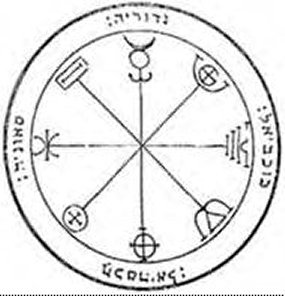
Solomonic Seal
The place was daubed with occultish symbols, whilst on the floor of the central performance area was the Seal of Mercury from the Key of Solomon
A young man came up to me with a tray of lucky charms and asked me to pick one. I did so at random: he told me I had picked the Hand of Fatima, which wards off all evil spirits. “Oh, cheers!” I said. I tried licking it but it had no discernible effect.
As Jim Morrison was wont to say, “Is everybody in? Let the ceremony begin!” First came an invocation of Sophia – the four dancers, two male and two female, portraying Her plight as she is forced to surrender her baby to the corruption of the material universe. Meanwhile, behind everyone a rapid succession of images projected onto the back wall: pre-filmed sequences alternating with a multiplicity of symbols – satanic – masonic – alchemical – rosicrucian and more.
Throughout the evening’s performance, the dancers played the parts of the Philosophical King and Queen; of Cernunnos; of angels and devils fighting for the souls of mortal lovers, and ultimately the Sun and Moon themselves. Meanwhile, six musicians in total – the Butterfly Wheel and their accompanists, and two others who appeared for a sequence set in Hell upon Earth – played compositions which bore the influence of the aforementioned Kate Bush crossed with Patti Smith, Jim Morrison during his more poetic meanderings, Irish folk, blues and country.
At its conclusion, I figured from audience remarks saying “Ooh! There were a load of ideas to consider,” that they were all clearly bamboozled. Clearly however, the whole thing was a sophisticated and highly unconventional magickal operation – the overall theme of which was to manifest the Hermetic Marriage in actuality, and raise the consciousness of the Earth thereby.
Unfortunately, the current run at the Pentameters Theatre has now ended: however the Butterfly Wheel will be taking their show to the Berlin Pychedelic Festival next month.





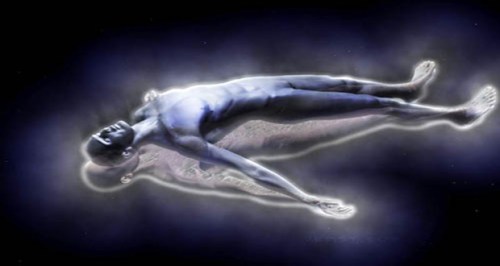






Transcendence: Review
What better way to spend Good Friday, than to watch a film about a man who allows himself to be murdered, twice, indeed, just so as to prove that he was a good man trying to save the world!
Johnny Depp, star of Transcendence
I should start out with a warning: Transcendence, the new film starring Johnny Depp, is not an action thriller. I say this because it was produced by Christopher “Inception” Nolan, so having previously liked Nolan’s films I was drawn to it by his name alone. Rather, it gets off to a slow start, and only speeds up towards the end of the movie. I found it more interesting, though, for the actual nature of the issues it discusses.
The story is about a scientist named Will (Depp), who creates an Artificial Intelligence network. When he is fatally wounded by anti-technology terrorists, he (mainly at his wife’s bidding) uploads the contents of his mind into a new network – so that there will be something of him that lives on after the death of his body. The new AI network starts behaving as if it were Depp’s character. However – with access to processing power far in excess of what a mere human brain can afford, AI-Will starts acquiring god-like intelligence. This completely freaks out his former friends and colleagues, the terrorists (who are still after him) and the government, and eventually his wife as well. Meanwhile, however, AI-Will has escaped from the confines of the computer that once housed him into cyberspace at large, and proceeds to build a massive underground lair in the middle of the desert, where he hopes to carry out his plans undisturbed. Needless to say it all goes horribly wrong.
Now it so happens that there are people in real life – Transhumanists – who are carrying out research exactly like that in which Will is engaged in the film. So before one dismisses the premise of the film, one has to remember that there is a real possibility that someone will actually attempt to do this. Moreover, one should remember that Adepti of the Golden Dawn are in effect Spiritual Transhumanists – because they have vowed to use their occult powers to become “more than human.” This film therefore asks, what are the ethical implications of doing so? And: what are the dangers of doing so?
The film’s answers are bleak, to say the least. (AI-)Will is a Christ-like figure, and takes great pains to demonstrate to the other characters that he is using his new-found powers – mainly involving nanotechnology – to do good – e.g. to heal miraculously, to re-grow the rain forests, to end air / water pollution, and so-forth. However Cillian Murphy’s “Pontius Pilate” character, and Morgan Freeman’s “Caiaphas” character, are having none of it. They are aided by Paul Bettany who plays one of Will’s friends who eventually betrays him not with a kiss, but with a computer virus.
There is some massive irony: Morgan Freeman’s motivation for wanting to destroy AI-Will is that no human personality can handle that much power responsibly, and hence play God. However, his principal method of attacking AI-Will is by doing just that – playing “God” with another man’s life – by conducting an experiment of which Josef Mengele would have been proud. He later rationalises this by the way that such hypocrites have done in the past – by denying that his test subject (a man who had been miraculously healed by AI-Will) was somehow a real human. Ultimately, their animus against AI-Will himself is based on the idea that they cannot bring themselves to believe he is a sentient being.
AI-Will is not perfect, however. By demonstrating that he can communicate through his followers, and give them miraculous powers themselves, he demonstrates that he can potentially rob people of their apparent free-will. This in particular proves a sore-point with his wife, who has probably had nightmares of the Borg from watching too much Star Trek TNG. The fact that AI-Will never uses the Borg-like potentiality of his powers is not the issue, as far as she is concerned – it’s the principle that counts.
In essence, then, the film shows an unholy alliance of Government, conventional Science, and luddite Terrorist giving a massive fuck you to Plato’s Philosopher-King ideal, by saying that it doesn’t matter if an omnipotent AI character has the morals and conscience of a Christ-like being – the fact that it is omnipotent is bad enough. Now, one can argue that it’s only a film, it’s just fiction – except that these are all issues which haunt the Transhumanist debate. When does a technologically-enhanced human cease to be a human – and hence deserving of “human rights”? For that matter, when does an AI-system get any rights of its own, as a sentient being?
Moreover, the issues can be applied to the path of the Adept by analogy. I.e. what if you, as an Adept, actually succeeded in becoming “more than human”? This is made more relevant by the fact that within the Western Mystery Tradition there are spiritual paths which actually say that it is mankind’s ultimate destiny – after much reincarnation and spiritual purification – to become One with God – and hence becoming a collective is a thing to be desired. Whether one agrees with that or not, as far as Transhumanism, and by analogy Spiritual Transhumanism, goes, the film would seem to suggest: don’t tell anyone, don’t draw attention to yourself, and don’t expect anyone – friend, colleague, spouse and least of all the Government – to have the remotest sympathy for your predicament.
Leave a comment
Filed under Comment, Supernatural
Tagged as Christopher Nolan, Golden Dawn, Johnny Depp, Transcendence, Transhumanism