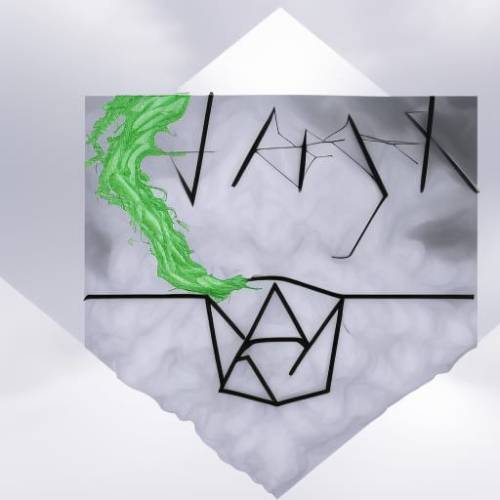
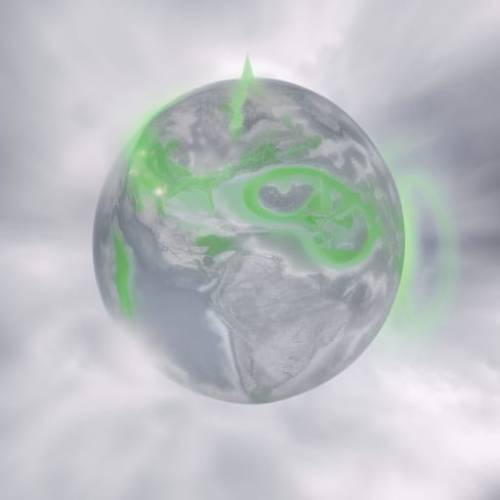
You have the ability to create – using online tools – Sigils which are visually far more interesting and varied than ever before. The above set of designs, for example, was four images created from the phrase: THIS MY WILL TO END GLOBAL WARMING.
Everyone who has at least a passing knowledge of Chaos magick will know about the technique derived from Austen O Spare, that of creating a sigil from a statement of intent by eliminating repeated letters and then manipulating the remaining letters into something which looks appropriate. Now, what I have been experimenting with is give the latter part of the process, the “manipulating the remaining letters” to an AI-art generator, to see what it would come up with.
The resulting images come from me eliminating repeating letters from the original phrase, which left me with THISMYWLOENDGBAR, which I made into a graphic thus:
You could probably use MS Paint, or just take a screenshot of having typed the letters out. I then uploaded this to NightCafe, and set it to work its wonders.
For those interested in the fine details, I first used the “Artistic” engine, selected “advanced options” and uploaded my starting graphic, and entered the following text prompt:
A Chaos Magick Sigil to end global warming, by Austen O Spare and Steffi Grant, a masterpiece, 8k resolution, 35mm, hyper realistic, hyper maximalist, hyper detailed, green
I then “evolved” the result using the “Stable” engine, which resulted in the four images you see at the top of this page.
In short, it is now not only possible but comparatively easy to create decent sigils very quickly using free resources on the internet. It certainly saves faffing around with a pen and a scrap of paper, which is what I had been doing up to now. When AI affords us with the means of not only creating sigils but raising the gnosis to empower, who knows what might be achieved!
Happy Equinox. The moment the Sun enters Aries is also, in Mundane Astrology, an indicator of what is going to happen in one’s country for the coming months or year. Hence I have drawn up a chart for the UK (see image). The precise location I have redacted from the image, save to say it is somewhere in the South-east of England.
Chart drawn up for the moment Sun entered 0º Aries (i.e. the Equinox).
Unfortunately it does not look good. The ascendant is in Scorpio, a Fixed Sign, implying that the chart applies throughout the next twelve months. More tellingly however, the Lord of the Ascendant is Mars, the planet of wars and conflicts, which is in the 8th House, the House of death! Tellingly, the Ascendant is in close conjunction with Cauda Draconis, implying that the country’s general condition of prosperity and health will be closely tied up with issues arising from its past (e.g. colonial legacy).
In fact, the difficultly placed Mars puts a dampener on much of the year, given that it is Square to the Sun (which represents the Government), and the Moon (which represents the People). I would therefore predict as follows:
The Sun
Prime Minister Rishi Sunak, in league with some dodgy criminals.
Represents the UK government, is in the fifth house. Government policy will be mainly concerned with legislation affecting children and young people, including gender-identity issues and sexuality. The industrial disputes that have been affecting public services will continue and not see resolution.
(Sun square Mars) There will be at least one major terrorism incident involving the assassination of a senior British leader, and this will colour the Government’s attitude to home security throughout the year.
The Government will generally enjoy good relations with the Press, and also with literary figures, and those in the entertainment industry.
However, the Government will also be involved in shady relations with criminals, and will quite hypocritically entertain people in private who are supposedly not aligned with the Government.
The Moon
Sir Keir Starmer, leader of the Labour Party, will succeed in groping for public support.
Represents the people. Pisces / 4th House.
The general populace will mainly be concerned with itself: politically, there will be an upturn in support for the Labour party (currently in Opposition) as indicated by the its placement in the 4th house and its conjunction with Neptune, the planet of socialism and collectivist politics.
The people will greatly resent the Government’s handling of the major terrorist incident mentioned above: one can infer will impact public consciousness greatly.
Conclusion
I apologise if this is rather bleak, but hey, I call ’em like I see them. However, there are ways for the people of Britain to leverage the stellar influences currently manifest to its favour. For example, the stars only really look bad for the current Conservative government. Get rid of the Tories, and people will be a lot happier. Moreover, the flip-side of Cauda Draconis being conjunct the Ascendant, is that Caput Draconis is conjunct the Descendant – implying that Britain’s future lies in having benevolent relations with foreign countries – dare I say it, the European Union?
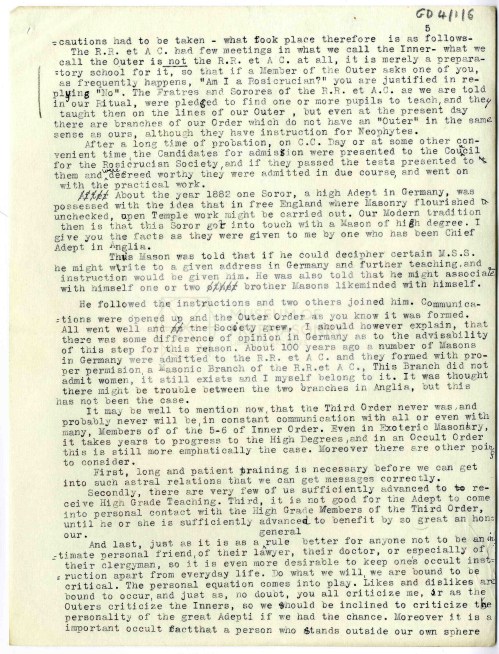
I have recently discovered an interesting titbit of information regarding Amoun Temple – the London based temple of the Stella Matutina, which was extant during the early part of the twentieth century. Specifically, what it used as its Vault of the Adepti.
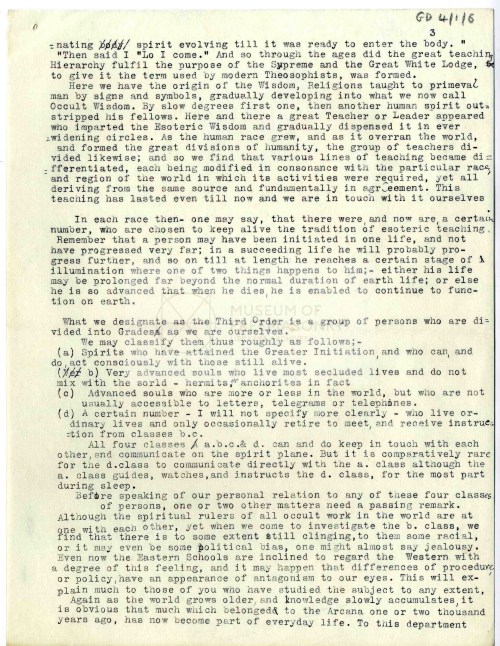
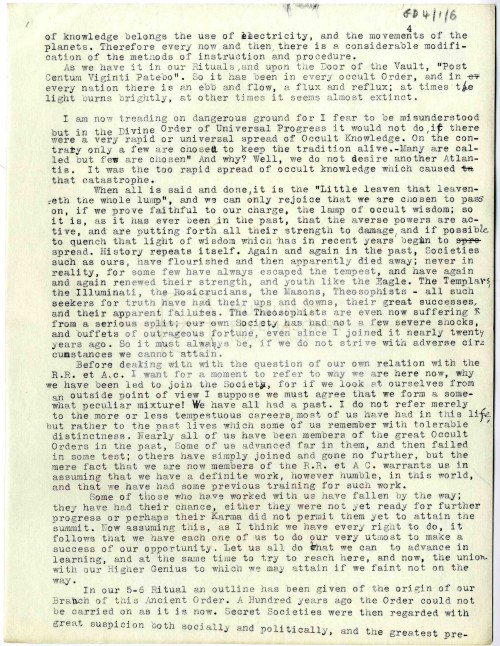
Amongst the papers emanating from Amoun Temple was one written by Finem Respice (Robert Felkin) concerning the use of the Vault of the Adepti. The main body of the paper is identical with the version reproduced in Regardie’s Black Brick: however, it has a short but intriguing preface.
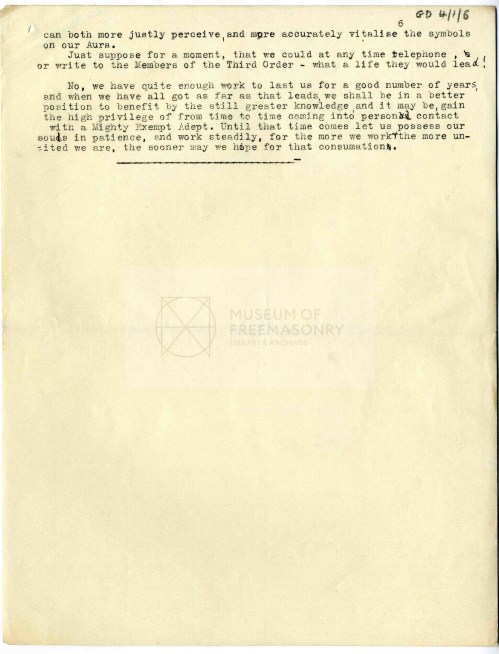
(It also has an after-word, describing the Third Order. I will not discuss this at this time, except to say that I consider Felkin’s take on it rather fanciful, and a perfect example of Floccinaucinihilipilification. I leave it here in case my readers get more from it than I did.)
Unfortunately we are unable for the present to have a permanent Vault, a permanent home for the Inner Order. It is the point at which I aim, and some day I hope we shall be able to afford an Inner Shrine.
Meanwhile, there is no reason why, when we are able for a few weeks to keep the Vault up, it should not be used by all who are eligible, and it has occurred to me that some remarks on its proper use may be appropriate at this time, as we do not intend to dismantle it till after Corpus Christi on June 15th. [1911]
G H Frater F. R. (Robert Felkin)
What this shows is that Amoun Temple did not have a permanently installed Vault of the Adepti. Instead, it appears that they only had one for a month or less each year, whilst the rest of the time it was either in storage or being used somewhere else (nb: this document is dated May 18th 1911, less than a month before Corpus Christi). During the short space of time that it was available, they worked all the Adept grades that were due that year, as well as the Corpus Christi Ceremony, in addition to affording time to Adepti to perform skrying in the Vault.
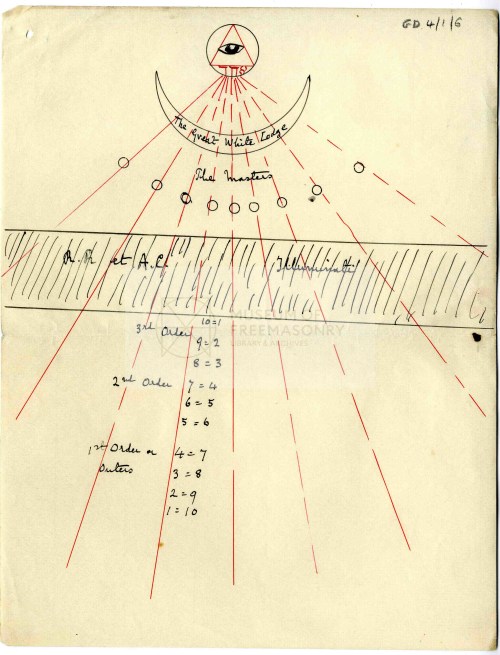
Quite apart from this document, which is in the archives of the Library & Museum of Freemasonry at Freemasons Hall in London, I have in my possession material from another source entirely which indicates that Amoun Temple worked all the Adept grades: Adeptus Minor 5=6; Adeptus Major 6=5; Adeptus Exemptus 7=4; as well as the Transmission of the Etheric Link. I presume that they must have done so using this arrangement: working them in a temporarily-installed Vault whilst they had it available. (I have seen no evidence that they worked the 8=3 and 9=2 grades, but that might be just be a shortcoming of the source of my data.)
This suggests a possible solution to modern Golden Dawn temples. Ideally of course one ought to have a permanently-installed Vault of the Adepti, but this implies that one is fortunate enough to have the venue suitable enough to house it. However, Amoun Temple itself only used a temporary Vault – and this was the temple of which no lesser person than W B Yeats was an alumni!
Unfortunately, Amoun Temple also listed Christine Marie Stoddard amongst its members, so one could argue that Amoun’s temporary Vault didn’t work 100% of the time. 😏
Most devout Christians will be so shocked and outraged to read this, they will scarcely believe this to be true. However it has come to my attention that there is a practice which has been growing in popularity in New Age circles over the past few months, referred to as “light codes” or “the language of light,” or some such similar title. Now for a long time, the idea that alien races such as the Pleiadians, the Sirians, et al., have been contacting humans, and that there are such people as “star seeds,” has been a popular theme in the New Age. However, the latest development is the idea that a seeker on this planet is able to access the benefits that these members of the Galactic Federation have to offer humanity through channelling their language – i.e. “the language of Light.”
In a nutshell, this involves tuning into the energies being transmitted across the universe, and then deliberately vocalizing one’s natural reactions thereto. If one were to record oneself doing so, one would not hear a recognisable language in the sense that a linguist would understand, and indeed its practitioners do not claim that the Light-Language is in any way translatable. However there are two important points which differentiate it from mere gobbledigook: firstly, it is obviously important to the particular person channelling it at that particular moment; and secondly, the mere act of attempting to do so itself the provides the benefit of the exercise.
I myself have practiced this, and can attest that it works, i.e. it can lead one into a deep state of meditation, which one could take as evidence that one is really in contact with higher spiritual energies. However: it ought not to be a surprise that it works – because far from being a recent innovation, Light-Language is really just a new iteration of an ancient phenomenon, and one that is mentioned in the Bible to boot, namely Glossolalia or “speaking in tongues.”
And they were all filled with the Holy Spirit and began to speak with other tongues, as the Spirit gave them utterance.
Acts 2:4
Glossolalia is first recorded on the day of Pentecost where it is presented as a miracle: foreigners of assorted nationalities each heard the words as if in their own language. Unless the Apostles were literally speaking one thing to one person whilst simultaneously saying another to another, I would suggest that the more obvious meaning is that both speakers and audience were infused with the Spirit, and each one heard the words in the language of their own soul.
By the time Saint Paul came to be writing his epistles, Glossolalia appears to have become a regular phenomenon in the early Church.
But the manifestation of the Spirit is given to each one for the profit of all: for to one is given the word of wisdom through the Spirit, to another the word of knowledge through the same Spirit, to another faith by the same Spirit, to another gifts of healings by the same Spirit, to another the working of miracles, to another prophecy, to another discerning of spirits, to another different kinds of tongues, to another the interpretation of tongues. But one and the same Spirit works all these things, distributing to each one individually as He wills.
1 Corinthians 12: 7-11 (emphasis added).
In other words, what appears to be happening is that in both Glossolalia and Light-Language, the speaker invokes a spiritual power and then vocalizes as it moves him or her to do so: the difference being that with the Light-Language the speaker believes this to be a message from a member of the Galactic Federation; whilst with Glossolalia the speaker believes the spiritual power to be the actual Holy Spirit.
Now one might well be speculating that whatever the explanation, the same psychic mechanism is operating in both instances, except that this is where the hackles of the devout Christian would rise at the suggestion that one is talking about the same thing. The irony from my point of view is that Glossolalia is not just something that died out two thousand years ago, but is actively practiced in modern churches in the context of the Charismatic Movement.
The basis of Charismatic Christianity is that the spiritual gifts mentioned in the above-quoted passage of 1 Corinthians 12 – i.e. the “Charisms of the Holy Spirit” – are alive and well and being practiced today. I myself came into contact with Charismatic Christianity when I was much younger. Its meetings are on the one hand of the “happy clappy” variety, but on the other they also include works of Spiritual Healing, and consequent ecstatic trances known as “resting in the Spirit,” and needless to say, plenty of people breaking out into Glossolalia at the drop of a hat.
Now I’m no anthropologist, but if someone started talking about a ceremony involving singing, ecstatic trances, speaking in tongues, spiritual healing, etc, and moreover posited that working miracles and the more can and do take place – and it is a thing to be encouraged that they do – I would first assume that they are talking about a full blown Magical Ceremony, similar to Voudoun or some form of Shamanism. Yet Charismatic Christians consider themselves to be entirely regular Christians: they would blanche if one were to suggest to them that Charismatic Christianity is in fact nothing less than Christian Occultism.
Nevertheless, I believe that groups that call themselves “esoteric Christians” or “Christian Occultists,” such as Rosicrucians or Gnostics and the like, can learn much from the Charismatic movement. Most magic I have come across in such groups tends to be highly ritualised theurgy: the Charismatic model demonstrates how one can bring the energy of quasi-shamanism into an Christocentric occult paradigm. The New Age movement demonstrates that the Charisms are potentially valid, but it strips the Christianity out of them: I suggest it ought to be up to Rosicrucian movements to rehabilitate them.
At a certain point in the Royal Arch degree, the blindfolded candidate is asked to read something he holds in his hand – which of course he cannot. Instead, he is forced to answer: “For want of Light, I am unable to discover.” Anyone with merest smattering of spiritual understanding will realise that the Light being referred to is Illumination from God, which I interpret as meaning that it is ultimately impossible to understand the true meaning of Holy words without Divine assistance. This in turn further implies that all scripture is in some ways Esoteric, as the true meaning, which comes from God, will always be more than what is written in black and white. How ironic that so many people over the past two thousand years or more – both believers and non-believers – have tried reading the Bible without praying for the benefit of Divine Intuition – or Grace – when doing so. Crowley said “If one were to take the bible seriously one would go mad. But to take the bible seriously, one must be already mad.” No, indeed! Attempting to read it without the benefit of Light would not make you go mad, but with Light, you would become MAD.
As previously noted, the profile of Mailänder (1843 – 1905) has risen in recent years due to the website Pansophers.com, of which the translator of the current work, Samuel Robinson, is the founder. Mailänder apparently had a spiritual awakening in 1877, which led him to become the leader of a group of spiritual seekers known as “The Covenant of the Promise.” Tellingly, the membership comprised mostly German and Austrian members of the Theosophical society, seeking a Rosicrucian path as opposed to the Eastern flavour espoused by Blavatsky.
Mailänder himself avoided publicity: instead, new members came to him by word of mouth, but he only accepted them after he consulted with what is described as his “inner word.” I rather suspect this was meant in the same sense as “Im Anfang war das Wort,” and hence was equivalent to the his Inner Christ. Once accepted, he would give each pupil individual teachings upon which to meditate, and hence ultimately discover their own “inner word.”
The main feature of this particular book, however, is a series of Mailänder’s teachings translated into English for the first time. Of these, the “Soul Teachings” comprise over four hundred cryptic statements with little apparent elucidation, e.g.
301 The first baptism is the attraction of Christ and the Crucifixion. Then we step into the Spirit of Truth. The second baptism is the reception of the power of spirit through accepting the Lord in the spiritual life. The third baptism is the conception of the Holy Spirit, which is the work of the spirit.
Robinson (2021) p200.
The above passage has at least three distinct layers of meaning: firstly, the bare meanings of the words themselves; secondly, the context in relation to Mailänder’s teachings in general. Mailänder characterised an individual’s spiritual progress into three stages which he termed “Baptisms.”
However, the third and most important layer is the meaning which the individual intuits after meditation – and the influx of Light from God, rather like the candidate for the Royal Arch degree. In this sense I see the similarity between Mailänder’s approach and that of Jakob Boehme, who noted that there is a barrier to full Divine knowledge which must be overcome, which “is not to be done by thyself, but by the Light and Grace of God received into thy Soul.”
The book also contains “Form Teachings” – to wit, Mailänder believed that certain signs appearing on one’s flesh (e.g. letters) could be interpreted as spiritual messages for the individual.
Overall, this book is essentially a reference work, ideally suited for an English-speaker wishing to investigate Mailänder’s teachings in detail. It is a rather curious read: because it is only newly-translated, it may come as a surprise to English-readers that here was a man for whom Rosicrucianism consisted of privately teaching a small group of followers in his parlour at home – yet after his death his students acclaimed him the greatest authority since Christian Rosenkreutz himself. He has languished in obscurity up to now, what with his wish for anonymity during his lifetime, and the fact that his works were not available, but hopefully that will now change.
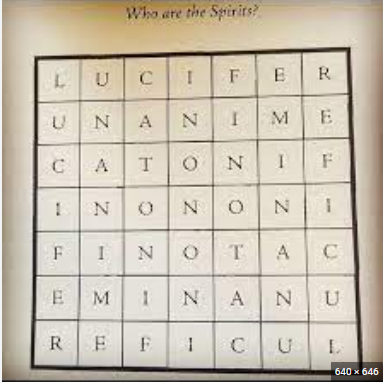
This post originally referred to a question on Reddit which I thought so interesting I would share it here… but then the OP deleted his post a few days later! Any how, the context was a discussion about this Abramelin Square:
Alex’ answer:
This is Square number 2 from the third chapter of Book 3 of the Book of the Sacred Magic of Abramelin the Mage – “To make [any spirit] appear in the shape of any animal,” although Mathers in his translation speculated that this should be to make a spirit appear in human form.
Usually with such squares, at least one of the lines refers to the Spirit who is responsible for making that square work. Alternatively, the top-line gives an indication of the meaning of the square.
This is actually an unusual square for two reasons. “Lucifer” is the name of one of the Kings of Hell, and although he figures prominently in the Abramelin system, he is far to high up the hierarchy of Spirits to preside over an individual magic square.
Moreover, most of the words in the magic squares (the ones which are words are not arbitrary letters to make up the acrostic pattern) are Hebrew words written phonetically in German. “Lucifer” by contrast is not a Hebrew word, but a Latin one (i.e. “Light-Bearer”).
However, it so happens the name “Lucifer” in Hebrew is Helel, which is also the name of one of the servant spirits, which do rule over this particular magic square (the servant spirits of Oriens, Paimon, Ariton and Amaymon). What I believe has happened is that the magician who first channelled this square came into contact with the spirit Helel, who told him to create a square using its own name but translated into Latin, hence rather cheekily making it look like its more famous namesake.
It would be quicker to list the similarities! Both are initiatory societies, with degrees (or grades), secret modes of recognition, passwords, and based around a sort of lodge system. This was mainly due to the fact that at the time the Golden Dawn was founded, it was the fashion to model any secret society on a lodge-system, whether it had anything to do with Freemasonry or not. It also helped that the founders of the Golden Dawn were themselves Freemasons, so they would have gone with what they were familiar with.
That being said, the main differences between Freemasonry and the Golden Dawn can be stated thus:
Firstly, Freemasonry (obviously) deals with the established Degrees of Freemasonry, but the Golden Dawn does not. This is important to remember, because Masonic Grand Lodges are critical of bodies which purport to be imitative of Freemasonry, and penalise people who belong to such bodies. The Golden Dawn gets round this by not attempting to imitate Freemasonry at all. Hence a Freemason could join the Golden Dawn without breaking any obligations, because the latter has got nothing to do with the former.
Secondly, although both Masonry and the Golden Dawn have a theme about searching for Light, they go about it in a completely different manner: the underlying narrative of the Golden Dawn in no way coincides with the Masonic “story.”
Thirdly, the Golden Dawn claims its rituals are Magical, and are performed in a magical manner: no such claim is made by Freemasonry in general. There is such a thing as esoteric Freemasonry where its practitioners claim that the degrees of Freemasonry are or can be magical, although they appear to be in the minority in relation to mainstream Freemasonry.
Fourthly, the Golden Dawn has a curriculum it obliges its members to study: and requires a member to pass examinations (written and, in the higher grades, practical) before advancing to a new grade. The Golden Dawn specifically focusses on the Qabalah, Ceremonial Magick, clairvoyance, astrology, tarot, geomancy, alchemy and hermeticism.
In Freemasonry this is not the case: to progress through Craft Freemasonry requires only the memorisation of a short piece of ritual. In Continental Freemasonry it is different, as candidates are required to write papers for each degree, although this is still unlike the examination system of the Golden Dawn. Moreover, Freemasonry hardly mentions anything like the Qabalah, although, again, esoteric Freemasons claim that the symbolism is right there though not recognised by mainstream Masonry.
Fifthly, the Golden Dawn was founded as a society for both men and women right from the outset. Mainstream Masonry tends to be male-only, although there is nowadays such a thing as Co-Masonry, which is viewed as outside the pale by purportedly “regular” Masonry.
I have not even begun to talk about all the cosmetic differences, such as different regalia, different rituals, different grade system, different temple lay-out, different officers, etc etc etc. Suffice to say that if one were in a Golden Dawn temple, there is no chance that one would mistake it for just another masonic ritual.
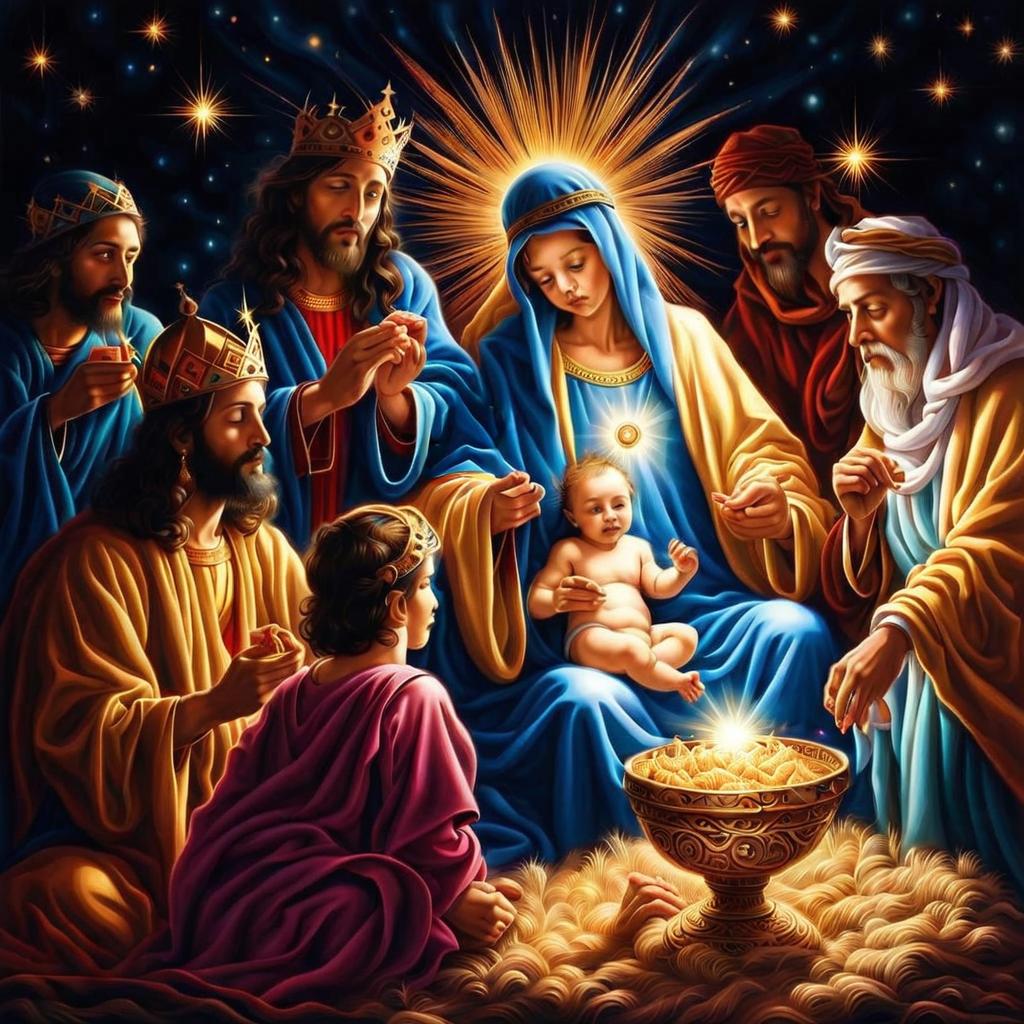
Happy Epiphany! Or, if you are a member of one of the Orthodox Churches, or are reading this in Africa, Merry Christmas! This post is a follow-up to my previous Epiphany-themed post, Jesus Christ: Pagan Messiah.
Astrologers are mentioned with high-praise in the Bible! All you Christian Fundamentalists who say that Astrology is evil, are ignoring the literal word of the good book, for the Gospel of St Matthew clearly says that the first foreigners to recognise Jesus as Christ were Astrologers. In fact, the Churches have instituted a day to honour the fact – today, the Feast of the Epiphany, January 6th.
Yes indeed. The Magi who came to offer gold, frankincense and myrrh were astrologers, who used their powers of casting horoscopes to predict the birth of the Messiah. The key to understanding this is the passage:
Happy Epiphany! Or, if you are a member of one of the Orthodox Churches, or are reading this in Africa, Merry Christmas! This post is a follow-up to my previous Epiphany-themed post, Jesus Christ: Pagan Messiah.
Astrologers are mentioned with high-praise in the Bible! All you Christian Fundamentalists who say that Astrology is evil, are ignoring the literal word of the good book, for the Gospel of St Matthew clearly says that the first foreigners to recognise Jesus as Christ were Astrologers. In fact, the Churches have instituted a day to honour the fact – today, the Feast of the Epiphany, January 6th.
Yes indeed. The Magi who came to offer gold, frankincense and myrrh were astrologers, who used their powers of casting horoscopes to predict the birth of the Messiah. The key to understanding this is the passage:
In the time of King Herod, after Jesus was born in Bethlehem of Judea, wise men from the East came to Jerusalem, asking, “Where is the child who has been born king of the Jews? For we observed his star at its rising, and have come to pay him homage.”
The phrase at its rising has been also been translated as “in the East.” This has given rise to an erroneous belief that there was an actual Star of Bethlehem, moving comet like through the sky to guide the Magi to the place of Jesus’ birth. Some have also speculated, also erroneously, that the passage refers to a planetary conjunction which occurred in 6BC. (NB: all stars rise in the East, simply because of the Earth’s rotation).
However, to an Astrologer, the passage takes on a completely different meaning. It refers to Jesus’ “rising sign” or Ascendant. Hence the Magi computed Jesus’ Horoscope. Incidentally, the Rising Sign is the literal “Horoscope” – the word means “house marker,” hence the Ascendant is the point from which the Houses of the chart are measured. Likewise they used the power of Astrology to identify the specific house in Bethlehem (it so happens that there is a method in Horary Astrology where the geographical location of a thing may be determined by the position of the ruler of the house under which it falls in the Horary chart – see, e.g. here).
This has given me a brilliant idea – the Christian Church should celebrate the Feast of the Epiphany as Astrology Day, precisely because it is the day when a group of Astrologers came to visit Baby Jesus. Given that every other Christian holiday inevitably becomes secularized soon enough, we may rely on the power of big business to soon open it up to people of all religions and none! Heck, if this idea takes off and finds widespread popular appeal, we shall soon have internet memes going round saying it was a pagan feast day all along!
“Mercury Retrograde holds no terrors… when all the unlucky stuff happens to other people.”
Mercury went Retrograde on December 29th 2022, and will station Direct again on January 18th 2023, in approximately three weeks time.
I find it supremely ironic that a no-mark of whom I had never heard before two days ago, chose the first day of Mercury going Retrograde to attack Greta Thunberg on social media. His reward consisted of not only being pilloried by the internet in general, and Ms Thunberg in particular, but his actions led to the Romanian Police detecting his presence in their country and arresting him. If you had doubts about the devastating power of Astrology, doubt no longer!
However, unless you really are a vile specimen of a human being, Mercury Retrograde need not necessarily be all bad: and indeed Hermeticism teaches us that by ascending to the right state of enlightened consciousness, we can survive the curveballs that this time of year throws at us. Furthermore, we ought to know that Mercury turns Retrograde around three times a year: thus because it happens with predictable reliability, we each can and ought to develop our own strategy or strategies for dealing with it.
As I wrote in my account of my own Abramelin Operation, 16th October 2020:
I had not paid much attention to the current stars and planets in the past few days, but I happened to remember that Mercury had just turned Retrograde (it had done so three days ago). It would not station direct until after I had finished the Operation. For one moment I felt uneasy that this had to happen now : would I have begun my Operation if I had realised ? But then I dismissed the thought. Given that it occurs three or four times a year, one inevitably cannot perform the Abramelin Operation without it turning Retrograde once during that time. Perhaps I had done well not to pay too much attention to the astrology of the situation, as otherwise I might have let superstitious dread cause me to miss this opportunity.
A lot of people fear this time of year, but as I discovered once after a supermarket cashier forgot to ring up a bottle of whisky in my shopping, Mercury Retrograde holds no terrors so long as all the unlucky stuff happens to other people. A sort of Schadenfreude view of the phenomenon. Besides which, I interpreted the message of Hermeticism to mean that ultimately one ought to develop oneself spiritually so that one can learn to stand apart from the influence of the planets, instead of remaining passively affected by them. This, I supposed, formed the whole rationale of the planetary magick of the Golden Dawn. Adverse astrological conditions might disquieten the great unwashed, but they should merely present a challenge to an Adept worth his or her salt.
Sumner (2022), p477 – see below for full bibliographic citation.
However: although practicing the Hexagram Rituals of the Golden Dawn, and by otherwise rising on the planes and raising one’s vibrational state does work, it only goes so far! The Curse of the Adept is that one has to continually deal with people who aren’t familiar with high Hermetic magic. E.g. as I recorded a few days later:
Later that morning : work continued awfully and threatened to spoil my day. Despite me being fastidiously careful, people tried to blame me for things which went wrong anyway. In other words, I had managed to transcend the effects of the Mercury Retrograde today, but my managers and co-workers had not, so I had to deal with their bullshit, nonetheless. In effect, I suffered from Mercury Retrograde by Proxy.
Ibid., p487.
In conclusion, my top tips for surviving Mercury Retrograde: DO
Spend time in meditation, and introspection. When a Planet is Retrograde, its energies are directed inwards. Hence although it is a bad time for outward expressions, it is a very good time for applying the power of Mercury to the inner life – through contemplation and cultivating one’s intuition.
Make plans for what you are going to achieve when Mercury stations Direct. The Retrograde period is a bad time for starting new ventures, however: it only lasts three weeks. Hence, this fact coupled with the idea of spending time on one’s inner life mentioned above means that it is an excellent time not for starting ventures, but for planning what you are going to start in the near future.
Try to remain calm: be compassionate and forgiving. Remind yourself that people who tick you off during this time are probably suffering themselves, and try to be as merciful towards them as you would want them to be towards you if you were in the same situation.
DO NOT
Start new ventures recklessly. Instead, if you can’t avoid putting it off, make an extra effort to make sure you have been especially careful. It would be foolish to say “never start something during a Mercury Retrograde” because that’s never entirely possible, so instead you should take this time to act cautiously.
Celebrate your return to social media by attacking the most popular climate change activist on the planet, disclosing public details when you are wanted by the police, or both.












 Sol Ascendans - The Website of Alex Sumner
How to survive Mercury Retrograde
Mercury went Retrograde on December 29th 2022, and will station Direct again on January 18th 2023, in approximately three weeks time.
I find it supremely ironic that a no-mark of whom I had never heard before two days ago, chose the first day of Mercury going Retrograde to attack Greta Thunberg on social media. His reward consisted of not only being pilloried by the internet in general, and Ms Thunberg in particular, but his actions led to the Romanian Police detecting his presence in their country and arresting him. If you had doubts about the devastating power of Astrology, doubt no longer!
However, unless you really are a vile specimen of a human being, Mercury Retrograde need not necessarily be all bad: and indeed Hermeticism teaches us that by ascending to the right state of enlightened consciousness, we can survive the curveballs that this time of year throws at us. Furthermore, we ought to know that Mercury turns Retrograde around three times a year: thus because it happens with predictable reliability, we each can and ought to develop our own strategy or strategies for dealing with it.
As I wrote in my account of my own Abramelin Operation, 16th October 2020:
However: although practicing the Hexagram Rituals of the Golden Dawn, and by otherwise rising on the planes and raising one’s vibrational state does work, it only goes so far! The Curse of the Adept is that one has to continually deal with people who aren’t familiar with high Hermetic magic. E.g. as I recorded a few days later:
In conclusion, my top tips for surviving Mercury Retrograde: DO
DO NOT
Sumner, A (2022), Conjuring Demons for Pleasure and Profit: an Abramelin Memoir, Thoth Publications, Leicester, UK.
Leave a comment
Filed under Comment
Tagged as Abramelin, Andrew Tate, astrology, Greta Thunberg, Mercury retrograde