

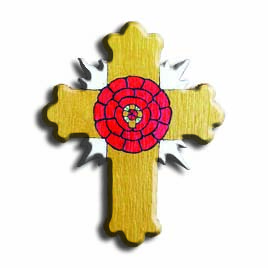
This is the first major book available in English which goes into detail about the “Golden and Rosy Cross,” the Masonic Rosicrucian Order deriving from Germany in the 18th century. I say “in English” because Bernard Beyer’s original text was first published in German back in 1925: it had remained untranslated – until now. But: who exactly were these Golden Rosicrucians?
The Gold und Rosenkreuzer (to give them their original German name) emerged in mid‑18th‑century Germany as a secretive esoteric fraternity blending Rosicrucian mysticism, alchemy, and Freemasonry. Although the order formally coalesced in the 1750s, its ideological roots were older: members traced their lineage to the early Rosicrucian manifestos and especially to Samuel Richter’s 1710 alchemical work published under the name Sincerus Renatus, which outlined doctrines later absorbed into the order.
The group was shaped most decisively by Hermann Fictuld, a Freemason and alchemist who reorganized scattered Rosicrucian currents into a structured initiatory system. The order developed a nine‑grade hierarchy, emphasizing spiritual purification, laboratory alchemy, and the quest for the Philosopher’s Stone. Candidates were required to be Master Masons: although as the translator of this edition points out, this was more of a pious aspiration. The rationale of the first, “Junior” degree required that the candidate be conversant with the symbolism of Freemasonry, including the secrets of a Master Mason. However, after the first degree the Order left Freemasonry progressively farther behind. There was no requirement, for example, that one must remain a Mason after having joined, in contrast to certain modern Rosicrucian Societies.
By the 1770s–1780s, the Gold und Rosenkreuzer had spread across Central and Eastern Europe, establishing lodges in Berlin, Hamburg, Vienna, Prague, Poland, Hungary, and Russia. Their influence peaked when Friedrich Wilhelm II of Prussia, sympathetic to Rosicrucian ideals, elevated several members—such as Johann Christoph von Wöllner and Johann Rudolf von Bischoffwerder—to positions of political authority, allowing the order to shape religious and educational policy.
Rivalries with the Bavarian Illuminati, internal secrecy, and political upheavals after Friedrich Wilhelm II’s death in 1797 accelerated the order’s decline. By the early 19th century, the Gold und Rosenkreuzer had fragmented, though their ritual structure later inspired groups such as the Societas Rosicruciana in Anglia and the Hermetic Order of the Golden Dawn. However: there are rumours that despite the original order’s decline, it did not go completely extinct (e.g. Gustav Meyrinck was alleged to be an initiate), and that the last lineage holder only died as recently as the 1990s.
As regards this book in particular: a lot of this material has been summarised and quoted by commentators before (e.g. Arthur Edward Waite), but this is the first time that the primary sources have been made available to the reading public. So unless you are a Rosicrucian fan-boy who likes to spend their time poring over old manuscripts in the Library & Museum of Freemasonry, you will not have seen a lot of this material before.
Thanks to this current book, it is possible to compare and contrast the Golden and Rosy Cross with its nearest modern analogue, the Societas Rosicruciana In Anglia (SRIA). Both are societies purporting to be Rosicrucian and which require its candidates to be Master Masons. They have similar sounding grade structures:
| Grade | Golden & Rosy Cross | SRIA |
| 1st | “Junior” | “Zelator” |
| 2nd | “Theoreticus” | “Theoricus” |
| 3rd | “Practicus” | “Practicus” |
| 4th | “Philosophus” | “Philosophus” |
| 5th | “Minor” | “Adeptus Minor” |
| 6th | “Major” | “Adeptus Major” |
| 7th | “Adeptus Exemptus” | “Adeptus Exemptus” |
| 8th | “Magister” | “Magister” |
| 9th | “Magus” | “Magus” |
| 10th | (no tenth grade) | “Adept of Christian Rosenkreutz”[1] |
But that is pretty much where the similarities end. In the first grade of the G&RC the candidate is immediately confronted by an initiation ritual which is heavy with Alchemical symbolism. That of the SRIA is more hermetic or qabalistic. In the second grade, the G&RC members literally learn about the Theoretical basis of Alchemy in a teaching environment. In the third grade, Practici must participate in a practical Alchemical working, albeit as students at this stage. From the fourth grade onwards, the candidate, as a condition of advancement, must perform increasingly complex alchemical operations himself: whilst in the final grade – of which there is very little data given – the candidate is implied to undertake Divine Magic.
In contrast, in the SRIA each grade involves a certain amount of ritual drama, but there is very little in the way of practical teaching given. Far from learning and taking part in Alchemy, its members are encouraged to research and write papers on esoteric subjects. In fact, I have heard it said that in the old days one could not be advanced to the next SRIA grade unless one actually had presented such a paper to the Society: if that had been the case, it would at least have made the SRIA if not an Alchemical society, then at least as rigorous as continental Freemasonry. However, by the time I came into contact with it, this had completely fallen by the wayside, and members were routinely advanced to the next grade a year after attaining their previous grade, notwithstanding whether they had made any contribution or even attended at all within the intervening twelve-months.
The book ends by announcing that there will be sequel to this volume entitled “The Golden and Rosy Cross: Ritual, Revelation, and the Legacy of Rosicrucian Alchemy.” I heartily recommend both the current volume and its forthcoming companion to all those interested in this fascinating aspect of Rosicrucian history.
[1] This was not part of the original SRIA structure. It started off simply as a Medal given to senior members of the Society for outstanding service, until the last but one Supreme Magus decided to create a ritual for it.






 Sol Ascendans - The Website of Alex Sumner
Oh God!
As anyone who has spent too much time in a pub on a Friday night will know, there is nothing more divisive a topic of conversation as Religion – except perhaps Politics. This must be the main reason why discussions on topics of Religion and Politics are banned in all Masonic lodges – because the lodge is meant to be a place of tolerance for people of all faiths and leanings.
Nevertheless, the topic of Religion has raised its ugly head in the Golden Dawn blogosphere this week – just in time for Ishtar, I might add – so I thought I would shove in my two pennyworth.
I am not going to criticise directly what other bloggers have written about the subject. Instead I shall just point out something that no-one has yet considered. The writers of the original GD rituals were Rosicrucians – more specifically, they were members of the SRIA. In one of the rituals of the SRIA, there is the following quote:
(Emphasis added)
Hence: when the Golden Dawn talks about “religion,” it is reasonable to suppose that what is meant is what Westcott, Mathers and Woodman – and their contemporaries -would have understood by the term, i.e. the pure concept of Religion liberated from dogmatic theology, or the true Internal Alchemy.
Leave a comment
Filed under Comment, Supernatural
Tagged as Alchemy, Golden Dawn, Nick Farrell, Rosicrucian, SRIA