How well do Occult orders actually teach their initiates? How well indeed do individual temples within those orders teach them? In order to formulate a general principle as to how students of the occult should be taught, I decided to delve into a realm far more esoteric than anything in the Western Mystery Tradition: namely, Educational Psychology. More specifically, I decided to compare what usually passes for occult training with a model which is used by teachers in high schools across the world, namely Bloom’s Taxonomy of Learning. The Taxonomy helps to classify just how a much a student has mastered any given subject which they are learning.

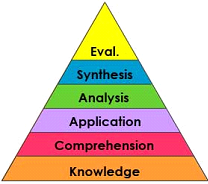
Bloom’s Taxonomy (original version)
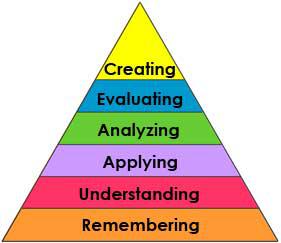
Bloom’s Taxonomy, as updated by Lorin Anderson. They are ranked in order of ascending difficulty
Benjamin Bloom (1913 – 1999), in 1956, led a group of educational psychologists who established six levels of intellectual behaviour important to learning. These levels were organised cognitive levels which ranged from simple recall of knowledge, to making judgements about the reliability and value of an idea. During the 1990’s Lorin Anderson (a former student of Bloom) headed a new group of cognitive psychologists and updated the taxonomy.
The six levels (i.e. of the updated taxonomy) may be summarised thus:
Remembering
Can the students recall or remember previously learnt information, for example facts, terms, and basic concepts from an educational text?
Understanding
Can the students demonstrate an understanding of the ideas or concepts stated in the text?
Applying
Can the students use the new information and apply it to actual situations?
Analysing
Can the students break down and distinguish between different parts and find evidence to support generalisations?
Evaluating
Can the students justify a stand or decision?
Creating
Can the students create a new product or point of view based on internal or external criteria?
A necessary implication of this is that a Teacher may well come up against *cough* *cough* I mean “come across” pupils whose maximum level of functioning is any one of these six. He or she may even have pupils at different levels within the same class! Therefore, in ideal circumstances the Teacher ought to have the acuity and the flexibility to, firstly, identify exactly at which the levels the pupils currently are and, secondly, adapt their approach as appropriate. Were all pupils in one class taught at exactly the same level in any given lesson, it is likely that pupils capable or only capable of operating at the other end of the scale would feel left out. And of course there is the danger that it the level were uniformly pitched for all in the middle of the scale, pupils at either end of the scale would feel left out.
Now let’s turn to how the mysteries are taught in occult orders, in the light of this taxonomy.
The most influential occult orders today were founded in the late 19th and early 20th centuries, i.e. before this taxonomy was codified. More worryingly however is that I have seen little evidence that they managed to incorporate these principles of their own volition, without reference to Bloom’s efforts. I have not actually seen much evidence that they have done so since, for that matter.
Take for example the Golden Dawn. If you shove a Knowledge Lecture under someone’s nose and tell them “memorise this,” you are only operating at the lowest cognitive level, that of Remembering. If then you base the exam for that grade on successful recall of facts of the knowledge lecture, e.g. by weighting the marking so that not many points are scored for showing anything other than Remembering, you will end up advancing people through the grades who show less independent thought than a fairly bright school pupil.

Did someone mention my name?
However, this is not a potential pit-fall of just one system. Take, by way of example, this quote from Crowley’s One Star In Sight regarding the tasks of the various grades of the A.’.A.’.
Neophyte. —Has to acquire perfect control of the Astral Plane.
(NB: a “Neophyte” here is a 1=10, which would be called a Zelator in the GD).
Now, what would the response be to a student who has the temerity to ask: “Hang on a sec – why ought a Neophyte to acquire perfect control of the astral plane?”
| Creating |
It is not necessary at all. I have worked outside the strict Thelemic tradition and have had success nonetheless. Hence I am better than Crowley! |
| Evaluating |
I have gathered independent evidence which tends to corroborate Crowley’s assertion that a Neophyte of the A.’.A.’. ought to acquire mastery of the astral plane. |
| Analysing |
It is not necessary for a Neophyte to do so per se – for example they could have acquired such control whilst they were working as a Student or Probationer – but it is necessary for them to be able to control the Astral no later than that stage in their learning. |
| Applying |
Because Neophytes come into situations at that particular stage of their magical development where perfect control of the astral plane is a necessity. |
| Understanding |
Because Crowley thought that Astral projection etc was essential to learn immediately after acquiring a general knowledge of magic and before attempting to master asana and pranayama. |
| Remembering |
Because Crowley said so, and if we don’t all do what he says then we are not singing from the same hymn sheet. |
| Below Remembering |
How dare you question the Great Beast 666! Get out, and do not darken my washroom towels ever again! |
So you see, applying Bloom’s Taxonomy to the occult is not just to inform them of the subject but to encourage the pupil to become a free-thinker on the subject. This may be a bit of an extreme example, so allow me to envisage something a bit more down to earth. Say for example the task is to design and consecrate a Talisman, for whatever purpose. Depending on what level the magical student is operating, the following might occur:
| Creating |
The student actually perceives flaws inherent in the principles he or she was taught, is able to come up with an original design and ritual which “corrects” those faults – and achieves success nonetheless. |
| Evaluating |
The student comes up with a radically new talisman design and consecration ritual – and then is able to cleverly argue that it adheres to the basic principles which he or she has already been taught after all. |
| Analysing |
The student can perceive the underlying structure of talisman design and consecration, and can produce a talisman (and its corresponding ritual) which displays a spark of originality whilst remaining within that structure. |
| Applying |
The student can just about design their own talisman and compose their own consecration ritual, though heavily relying on previously published data and synthesising other people’s rituals. |
| Understanding |
The student has to use someone else’s design and ritual, but at least has the beginning of a clue as to the meanings thereof. |
| Remembering |
The student can only copy someone else’s design, and consecrate it by following verbatim a ritual written by someone else, and even then does not understand either the design or the ritual. |
| Below Remembering |
The student cannot design or consecrate a talisman at all. |
Becoming a free-thinker when it comes to the occult is all well and good, but the problem is that so little published information on the occult is geared towards teaching students the art of free thinking. It is as if occultists believe that Free-Thinking is a character trait, which you either have or have not – whereas Education Psychologists believe it is a thing that can be taught and is ideally the ultimate end of education.
The very many new-age / fluffy bunny books which are available work at the Understanding / Remembering levels – sometimes cynically as a marketing ploy, but other times innocently because they are intended for complete beginners. Alas for their readership, who may not realise that (according to Bloom) there are four levels of cognition above the teachings given out in their favourite author’s book! I could also make a remark about some occult orders deliberately keeping their members at the lower levels of cognition because they are afraid of free-thinkers … But the greater deceit is practised by fiery Mars-obsessed writers with Uranus on the Midheaven who roundly decry the bullshit of such orders only to lay down their own dogma which is just as doctrinaire as that which they criticise.
So, in conclusion, I leave you with the following gristle on which to chew. Where on Bloom’s Taxonomy lies your tradition? Where lies your particular teachers? And most importantly – where are you?




 .
.






 Sol Ascendans - The Website of Alex Sumner
What The Stars Have In Store For Pope Francis I: Update
His Holiness Pope Francis I
NB: This is an updated version of the page which originally appeared here.
Pope Francis I (born Jorge Maria Berguglio, December 17 1936 in Buenos Aires) was announced as the new Pontiff at 7.06pm local time at the Vatican City. Using this information I have attempted to draw up charts for Francis I himself and for the moment of his election, and compare the two.
I found myself, however, up against an immediate problem that I did not have birth-time data for the new Pope: I have therefore attempted a spot of Chart Rectification. Looking back through the notable events in his life so far, according to his Wikipedia entry, I noticed that in 2001 not only was the then Archbishop Berguglio appointed Cardinal, but he also attracted a lot of (favourable) publicity to himself by visiting an AIDS hospice in Argentina. I am therefore willing to bet that the date of his appointment as Cardinal coincided with Jupiter crossing his Midheaven. This would imply that his Midheaven is 2º 25′ Gemini.
Based on this assumption, Pope Francis I’s birth-time according to his rectified chart would be 11.09pm (local time for Buenos Aires). This would make him a Sun-Sagittarius with Leo-Rising.
Inner Ring: (rectified) natal chart for Pope Francis I (Cardinal Jorge Berguglio)
Outer ring: chart for announcement of his election as Pope.
There are a number of intriguing observations to be drawn from both the Rectified Natal Chart and the chart for his election as Pope, e.g.:
Whilst a Cardinal he was doctrinally conservative, so thoughts of marriage can probably be discounted. Note that this applies to a general period in Pope Francis’ life which started approximately three months ago and whill last over a year.
General Predictions for Pope Francis’ Papacy
Unfortunately for those hoping for an early end to the Catholic Church, it is exceedingly unlikely during the reign of this particular Pontiff. Looking at the chart for the announcement of Pope Francis’ election – the Sun, representing the government of the church, is fairly free of bad aspects but conjunct Mars and Venus. This would suggest that the new Pope Francis will bring a new burst of energy to the papacy, increase the Church’s patronage of the Arts, and generally solve disputes rather than cause or exacerbate them.
However, it is not all good news. Jupiter, representing the Hierarchy (i.e. the priests and bishops), is square to Mercury (retrograde), the planet of unfortunate PR disasters, and Neptune, the planet of shady cover-ups – suggesting that scandal will nevertheless dog the Church during Francis’ reign. NB: I mean revelations of new scandal, rather than just continuations of the current ones.
Also: Pluto, the planet of large explosions, is giving grief to Uranus, the planet of revolutionary change, so whilst this Papacy may not see the end of the church per se, the fervour of the Church’s enemies will not be undimmed, and there will even be at least one major terrorist atrocity which badly affects the Church.
6 Comments
Filed under Comment, Religion, Supernatural
Tagged as astrology, Chart Rectification, Pope Francis I