
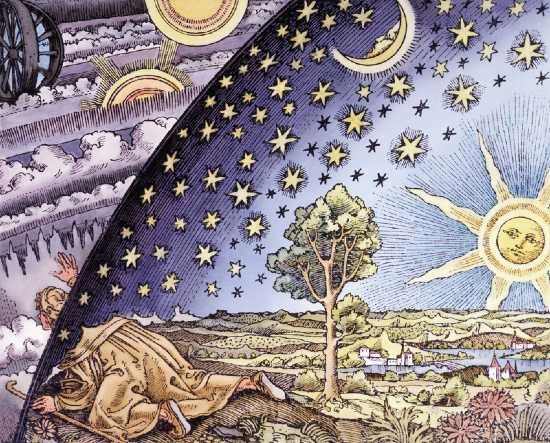
A real Hermeticist would be able to crawl all the way through.
Horary Astrology is the art of using Astrology to answer a particular question. Essentially the astrologer notes the time, date, and place that he or she first heard the question (or if it is on behalf of oneself – when he or she first formulated the question). This becomes the moment the question is “born,” and the astrologer can then draw up a chart for it in the usual manner and interpret it to gain insight into the circumstances in which the question arose, what is likely to happen, and what the eventual outcome will be. Horary Astrology is slightly different from Natal Astrology, although the similarities are such that one who has already mastered the latter can easily learn to practice the former.
The leading text on the subject is Christian Astrology
Being a Tarot reader as well, I find the Horary art intriguing, as it indicates a way that Astrology may be successfully combined with Tarot, to wit: by making a note of the time, date and place of when a question is asked for a tarot divination, one ought to be able to use Horary Astrology to double-check the results. Presumably if one’s astrological and tarot skills are as highly advanced as one another, one should find that the combined readings come up with the same results. In practice I find that the two types of reading complement one another, with each one providing extra details which are not apparent with the other.

Fifteen card tarot spread
So for example: the Tarot spread which I use most often is the fifteen-card spread, mainly because this was recommended for use with the first deck I ever bought, The Golden Dawn Tarot
Here then is a table of comparison between Horary Astrology and Tarot, specifically the fifteen-card spread.
| What | Horary Astrology | 15 Card Spread |
|---|---|---|
| The circumstances in which the question arises is determined by… | Luna, which represents the question itself. Its position in the chart gives information relating to the nature of the question. The distance of Luna from the last planet it conjuncted can be used to work out the date of a past event which has led to the current situation, or whether the cause is too remote in time. If Luna is “Void of Course” (i.e. it does not form a major aspect with any other planet before it leaves that particular sign), it indicates “Nothing will come of this question.” | The central three cards, 2 – 1 – 3. The first card usually indicates the prime or main meaning whilst cards two and three aid in its interpretation (NB: in GD spreads, there are no “reversed” cards. Instead a card is “well-dignified” or “ill-dignified.” Dignity is determined by whether nearby cards are of a harmonious or inharmonious nature.) |
| The development of the question in the short-term is determined by… | It depends – a horary figure admits some versatility. If the Querent is the astrologer him- or herself, the position of the Lord of the Ascendant will generally indicate what is likely to happen. The “Lord” of the Ascendant or indeed of any other given house is the Planet which rules it. In Horary Astrology Planets tend to represent actual people or things in the life of the Querent.If the Querent is someone else, then they will be represented by the Lord of the Descendant. If however the Querent is not asking on his/her own behalf but on that of someone else (e.g. a relative) or of something related to the Querent, then a house is selected to represent it and the Lord of that is examined. E.g. the tenth house relative to the Ascendant represents the Astrologer’s mother; the eleventh house relative to the Descendant (i.e. the fifth) represents the Friend of a querent where the querent is someone else, etc. | The cards along the top row. The three on the right represent what will happen if the Querent does nothing in particular to changer his/her fate; the cards on the left represent what will happen if they do try something. Each triad of cards is interpreted in a similar manner to that above, with the left and right cards determing whether the middle card is well- or ill-dignified. |
| The end of the matter is determined by… | The fourth house, and its ruler. Also, in a manner similar to that mentioned above, the position of Luna can also be used to determine when in the future a decisive event will occur. | The cards along the bottom row. Those on the right can be imagined as being what will arise as a consequence of those on the right top-row; similarly with those on the left, mutatis mutandis. |
| Miscellaneous extra information is given by… | Lilly’s work, cited above, gives examples of how a Horary figure may be used to extra effect in certain particular cases, e.g. finding lost items. A complete list of all the possible applications would be to long to put here. | The number of each different type of card may also add another layer of interpretation, for example: the number of Aces, the number of Court Cards, the number of Trumps, and the number of cards of a particular suit. Personally, I only look upon the number of a particular type of card as significant if it is noticeably greater than the average number one would expect from an evenly shuffled deck. I.e. out of fifteen cards, the average number of
|
| The relative merits of each type of divination are… | Horary astrology aspires to give a more mathematical or precisely vision of the outcome of the question. Being somewhat arbitary it provides a tough yard-stick which forces the diviner to consider factors which might not have been apparent in a more subjective system such as tarot. | Whilst not having a mechanism for being as definite as to dates etc as a Horary figure, I find the tarot cards provide more nuances of meaning than is suggested bylooking at the planets alone (this may just be a personal opinion.) |




 Sol Ascendans - The Website of Alex Sumner
How To Use Satanism To Market Your New Book
Aleister Crowley (1875 – 1947)
Aleister Crowley has been condemned for many things such as leading a debauched life of sex, drugs and Eastern mysticism, and for making the Occult popular today. He has also been praised for many things, such as leading a debauched life of sex, drugs and Eastern mysticism, and for making the Occult popular today. He has of course also been made the subject of a number of unfounded allegations, of which I thought I had all heard – until now. Whilst reading the Evening Standard (hey! I was bored) yesterday, I came across the newest allegation, in a full page article luridly entitled: “Were six bizarre deaths, linked to curse of King Tut, actually the work of this notorious Satanist?”
Apparently this is the theme of a new book published this week called London’s Curse: Murder, Black Magic & Tutankhamun by a chap called Mark Beynon, whom the Evening Standard describes as a “historian.” The Curse of Tutankhamun has been the subject of books before, but this new work focusses on some half a dozen deaths allegedly connected with it. Amongst those cited are:
Now Howard Carter first breached the seal of Tutankhamun’s tomb in November 1922, only fully entering the tomb in February 1923. The original idea of The Curse arose from Lord Caernarvon dying just three months after stepping inside, in April 1923. Thereafter, a number of deaths of people connected with the expedition in relatively quick succession poured fuel on the notion.
Hence: although Aubrey Herbert’s demise looks pretty ominous, the other deaths cited begin to look increasingly improbably due to the remoteness in time from the opening of the tomb (Howard Carter himself died in 1939). Also note that two of the people in the list above were in their late seventies, so Lord Westbury’s demise could have been an accident due to his infirmity.
Ah, no! Says this new book. They were in fact all murdered by notorious Satanist Aleister Crowley! Indeed, Crowley rushed over from North Africa to London in 1923 to murder Aubrey Herbert, and then plotted the deaths of the others over an eleven (!) year period. Now here is the kicker: the reason that Beynon concentrates on these as well as certain others is apparently because that their places of death, when plotted on a map of London, form a Pentagram, which is obviously a Satanic symbol.
Where can I begin to pick apart this notion? Well for a start there is an allegation in the book that “Crowley murdered his servants while in India.” I presume this is a reference to the infamous Kangchenjunga incident in which one of Crowley’s fellow mountaineers and two servants died not through being murdered but in an avalanche. (Crowley did attract notoriety for this, not for causing their death but for not going to help them after they had suffered their accident, thus breaking the code of honour commonly observed by mountaineers). However the most glaring flaw in the whole scheme is the inclusion of Wallis-Budge. Wallis-Budge retired from the British Museum in 1924, only a year after the opening of the Tomb, and was not directly involved in the Expedition. Crowley would however have had reason to be grateful to Wallis-Budge, as the latter was the pre-eminent translator of classic Egyptian texts such as the Papyrus of Ani (aka The Book of the Dead ).
).
It seems fairly obvious to me that Wallis-Budge’s death has been included for the sole purpose of finding fifth point for the overly-contrived Pentagram-theory. Indeed, poor old Aleister Crowley seems to have been picked upon simply because he was the most famous occultist around the time of the alleged events. Never mind that there were other students of the Egyptian mysteries alive during the whole time period! I suppose it was probably too difficult to actually find evidence against one of the more obscure occultists of the time period, although were Mark Beynon a real historian, in the academic sense of the word, this kind of task would be par for the course.
All in all, the attendant press-hype is a good example of how to use Satanism to market your new book.
THE NOVELS AND SHORT STORIES OF ALEX SUMNER – NOW AVAILABLE FROM AMAZON AND ITUNES (the author would like to point out that rather than scholarly historical works, his books are most definitely fiction!)
3 Comments
Filed under Comment, Supernatural
Tagged as Aleister Crowley, London's Curse, Mark Beynon, Satanism, Tutankhamun