
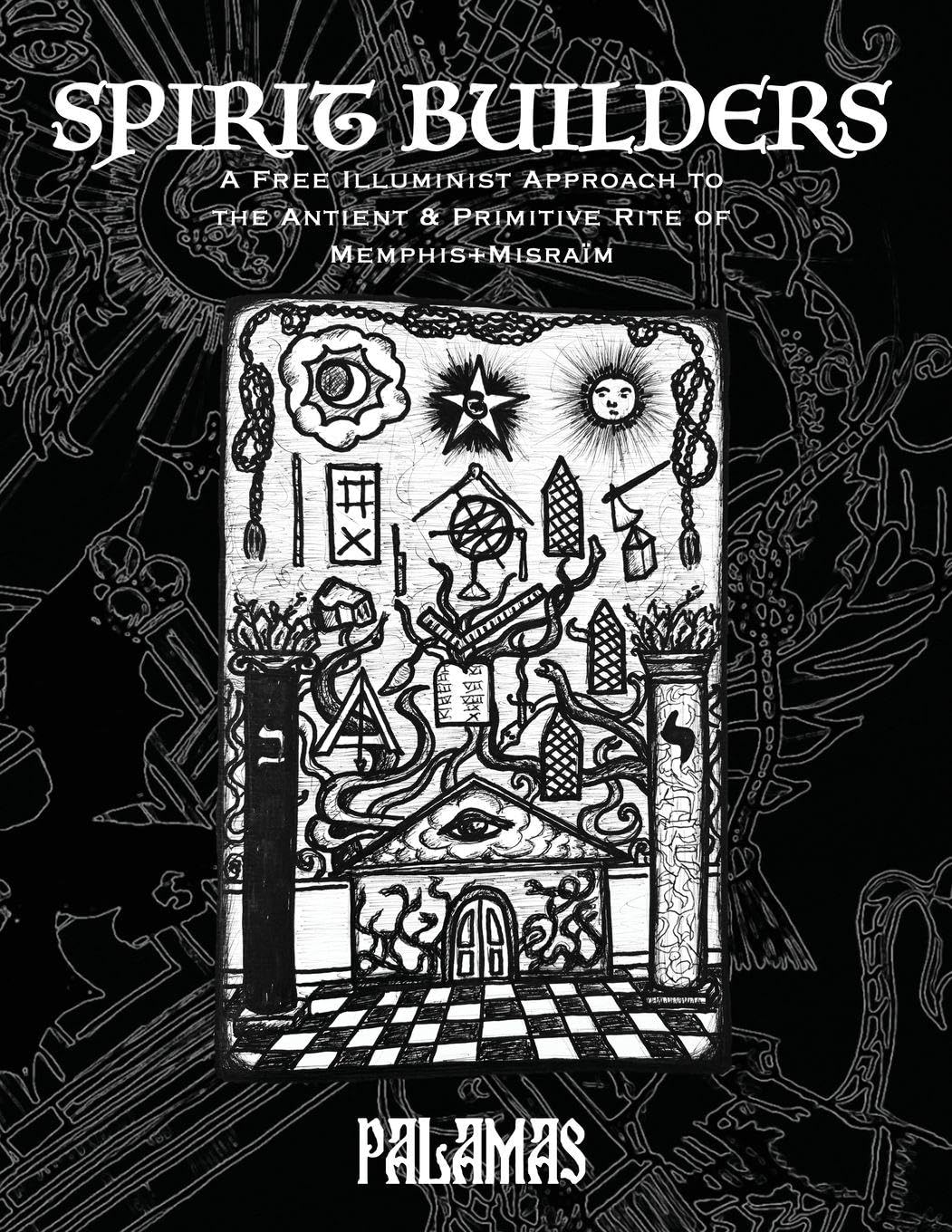
Peace profound, my Brethren! Salutations on all points of the triangle, and honour to the order!
During 2025 I had the honour to have conferred on me the 95º of Memphis Misraim, that of Patriarch Grand Conservator. It occurred to me that, seeing as I am now a nominal holder of all the degrees in that rite, it might be a good idea to start learning about them! I had in fact already read widely on such information as was readily available on the subject, mainly books by John Yarker and Robert Ambelain, as well as Matthieu G Ravignat, the latter of which will form the basis of another post on this blog in due course.
Then I came to this book, “Spirit Builders,” which presents a radically different point of view entirely. But first, some exposition:
Memphis Misraim is a masonic rite of ninety seven degrees, although properly speaking it consists of ninety degrees, plus seven administrative degrees tacked on for good measure. Why ninety? Because there are 90º in a Square, and the Square represents the Craft as a whole. Hence, once one has experienced all ninety degrees, one has experienced every permutation of what the Craft is or could be: that is the theory, at any rate.
A special point to note is that unlike male-only masonry, there is heavy emphasis on Alchemy in the rite, and even on Theurgy (i.e. ceremonial magick). Whereas some people have argued that it is implicit in the symbolism of male-only masonry, in Memphis Misraim it is very definitely made explicit. Indeed, if it had not, I doubt I would have been interested in it.
However, in practice, not all of these degrees are worked. Some “Sovereign Sanctuaries” (the Memphis Misraim equivalent of a Grand Lodge) only work as few as ten degrees, not even all of the degrees for which John Yarker published full rituals. The rest of them are conferred in name only, similar to the practice of the Ancient & Accepted Rite of male-only Masonry: and for the same purported reason: if each degree were staged as a full-blown Masonic ritual, it would take many months or indeed years to acquire the whole.
We thus come to the “Free Illuminist” approach, espoused by Tau Palamas, the author of the work currently under consideration. As I understand it, “Free Illuminism” aspires to confer all ninety-seven degrees, in particular the mystic and psychic attributes thereof. Not necessarily all in one go, but certainly sooner than the many years it would take otherwise. In this way each initiate is able to scry into the inner nature of each degree conferred, so that it becomes a step in a path of spiritual development. This the Free Illuminists achieve by stripping out of the ninety-seven degrees of all its Masonic Ritual content.
This ought to come as a delight to esotericists who believe that too much or even any Masonry can spoil the Occult. Hence, instead of a ceremony lasting at least an hour and requiring elaborate preparations, each degree becomes an “empowerment” which can be administered in a matter of minutes, with the “Secrets” of the degree becoming the proving-signs which the initiate can then use to scry into its properties.
The original idea of Free Illuminism derives from Allen Greenfield, who first associated the ninety-seven degrees with ninety-seven acupuncture points on the human body (mostly conforming to the Middle Pillar of the Tree of Life), classifying them as Points-Chauds (“Hot points”), which in turn is a concept deriving from Michael Bertiaux. Alas! I used to have Greenfield’s book “The Compleat Rite of Memphis” in which he first set out this schema, but I appear to have lost it the last time I moved house!
Palamas, the current author, has taken the idea of “Free Illuminism” one stage further by developing the idea of “Congregational Illuminism,” i.e. of practicing Free Illuminism within a community of initiates, mostly centred in Georgia, USA, but with other groups practicing across America and indeed the rest of the world.
This book itself contains useful summaries of all ninety seven degrees of the Rite, so from that point of view it becomes a Cliff Notes version of Memphis Misraim (actually useful to me in my own situation). However, it contains much more in addition, detailing the particular rituals of Congregational Illuminism, and describing the Arcana Arcanorum practices, as well as a method of linking the degrees to the 91 parts of the Earth in Enochian Magic. I have to say that in doing so he suggests a method of scrying the Thirty Aethyrs which seems blindingly obvious now I come to think of it, but which would nevertheless avoid all the difficulties – and horrors – which Aleister Crowley encountered in The Vision and The Voice.
I must say that I enjoyed Palamas’ style of writing: anyone who quotes W L Wilmshurst, Israel Regardie, and Chic & Tabby Cicero in the way that he does automatically gets my approval. I also found it instructive to follow up his references to Michael Bertiaux’s writings. Ye gods! The Voudon Gnostic Workbook is completely bonkers!!! However, I enjoyed reading Cosmic Meditation, and found it one of the very best books on the subject.
I have had a chance to compare the newest edition – which my fiancée got me as a Christmas present – with the first edition of the same book, and am pleased to note that Palamas has included new material with this publication, in particular details of an elaborate ritual for the Congregational Illuminists’ version of the 66º, Patriarch Grand Consecrator, which effectively is a theurgical rite of consecration as a Gnostic Bishop. NB: the edition I received was the Standard Edition, a hefty 738 page tome in black and white. There is also a deluxe full-colour version in two volumes, which I believe includes the colour plates originally found in the first edition.
One difficulty arose in my mind as I read this book, which I did not recall seeing resolved in the text, but it was this: the 97 points-chauds are, as I said, associated with acupuncture points on the human body. During each empowerment, the Initiator will touch or press the corresponding point to activate the point-chaud. However, the books states that many of these points are actually in bodily locations which, to put politely, if someone were to administer an empowerment there I would assume that they were proposing marriage to me. Needless to say, I have not received those particular empowerments yet, so I am intrigued as to how they could be feasibly be carried out, to put it lightly.






 Sol Ascendans - The Website of Alex Sumner
Review: “The Divinatory Arts” by Papus
The Divinatory Arts by Papus
Papus (Gérard Anaclet Vincent Encausse, 1865 – 1916), was a leading figure of the French Occult scene at the turn of the 20th century. He authored “Tarot of the Bohemians,” and founded or co-founded the Martinist Order and the Order Kabbalistique de la Rose-Croix. He was also a leading figure in Memphis Misraim and the Gnostic Catholic Church. He was even a member of the OTO, before Crowley got his mits on it.
He was also very briefly a member of the Golden Dawn, i.e. he only ever attended one meeting, and didn’t stay for the whole thing at that.
Despite being the very essence of “Occult,” Papus at one stage went mainstream by penning a series of articles published in Le Figaro, which is now France’s biggest newspaper, although back in 1895 when the articles were written, it had a more populist stance. Still, that would be like if you were to imagine me, Alex Sumner, being employed at a generous salary by The Daily Telegraph to write for it.
Hence, Papus ended up writing about Graphology, Palmistry, Physiognomy, as well as astrology. The content of these articles was necessarily only a brief introduction to the subject matter – understandable as they were intended for publication in a newspaper. This book, is the first time that these articles have been translated into English.
Although this is an interesting reference for someone researching Papus’ life, Papus’ own writing here is far from being the most interesting thing that Papus had ever done, given that he had lived such rich and full life. In that sense, the Translator’s own introduction is actually more interesting from an esoteric point of view. Nevertheless, I did find some merit in reading about palmistry and graphology, which were subjects I had never really touched upon.
I had to laugh at one point at Papus’ blatant chauvinism – he assumes, for example that the only reason a man would study Physiognomy is so that he can dominate any woman irrespective of her temperament. Nevertheless, the book as a whole is a curious piece in the larger jig-saw puzzle of the life of an otherwise great occultist.
The Divinatory Arts by Papus; translated into by “The Three Luminaries” © 2020, ISBN-13: 9798684181795. Available from Amazon.
2 Comments
Filed under Comment
Tagged as amazon, book review, daily telegraph, Martinism, Memphis Misraim, Papus