Tag Archives: Enochian Magick

The Order of the Cubic Stone

Way back in the dim distant past (i.e. the 1990s), I would scour my local library for absolutely any books they had on the occult at all. Amongst the inevitable dross I did find some gems, which however disappeared from the library altogether after I had returned them: subsequent borrowers not being as honest as me, I would imagine.

One book, however, which I found which was more valuable than anything else was a slim volume entitled Elizabethan Magic by Robert Turner. This was the first time I had found anyone who had written about the Enochian system in detail. I wanted to find out more about this abstruse magical system: so that when I came across Regardie’s Black Brick, and discovered by skim-reading it that the Golden Dawn itself incorporated Enochian magic into its teachings, I decided to invest in it – both in terms of time and effort – and hitch my wagon to the GD from that point forward. Yet I have to admit that this book by Turner definitely influenced my choice of direction.

I subsequently learned the full story: that Turner and a chap called Dave Edwards had, in the 1960s, founded a magical order they called The Order of the Cubic Stone, which had a public face in the form of its journal The Monolith – scans of some copies of which appeared floating around the internet. The story of the Order it described was that two young occultists contacted a Spirit Guide which told them to form an order like the Golden Dawn, but with the errors in the Enochian system corrected by reference back to the original Dee manuscripts.

Looking at Regardie’s black brick it is easy to see what this Spirit Guide meant. The four Enochian tablets published in Regardie’s set of tomes often had multiple letters in various squares: whilst large parts of the total material given by the angels to Dee is just plain missing: for example, the Holy Table, the Sigillum Dei Aemeth, the Tabula Bonorum Angelorum, as well as a full explanation of the 30 Aethyrs and 91 governors of the various parts of the Earth.

We now know that the Enochian material used by the original GD was a lot better quality than that published by Regardie: for example, it used the proper lettering of the four watchtowers, derived from the reformed table of Raphael. Moreover, I myself found evidence that at least by 1916, Adepts in Amoun Temple of the Stella Matutina, the GD spin-off, were at least aware of the other parts of the Enochian system, e.g. the Sigillum Dei Aemeth. It would appear that the material which came into Regardie’s possession and which he subsequently published had been corrupted from the original in relation to the Enochian system – as indeed to the rituals generally.

However, the scholarly resources we have now would not have been available to Turner and Edwards back in the 1960s, which means that their efforts to “correct” the Enochian system were all the more pioneering.

Now it so happens that modern GD orders do not rely on the material published by Regardie as is, but have actually made an effort to go back to the original material, and have even incorporated those parts of the Enochian system missing from the black brick. This makes me suspect that The Order of the Cubic Stone inspired modern GD orders – not necessarily because they used the OCS’ material, but because the OCS’ integrity and fidelity to its sources goaded them into upping their game.

As to what has become of the OCS, both Turner and Edwards have passed on, as indeed has Turner’s wife Patricia who was herself a leading member and organisational force in the Order. Nevertheless I believe there are OCS members about somewhere – one of them made himself known to me at the recent Welsh Occult Conference – they are, amongst other things, working to ensure that their publications are still available for modern occultists.

Leave a comment

Filed under Comment

New Avatar Power: Using Enochian without telling you!

A lie gets halfway around the world before the truth has a chance to get its pants on.
Winston Churchill

One error, repeated often enough, can reproduce exponentially like bacilli. So if you ever hear of something becoming part of the “culture,” you should immediately question what culture that actually means. Anywho, the central thesis for today’s blog post which I want to present to your notice is this: people who have been using “New Avatar Power” magic – and magic derived or inspired therefrom – have been using Enochian magic all this time without realising it.

The Miracle of New Avatar Power by Geoff Gray-Cobb (new edition)

The Miracle of New Avatar Power by Geoff Gray-Cobb (1974) was in many ways typical of the output of Parker Publishing in the 1970s – i.e. America’s answer to Finbarr Books – however, once one strips out the egregious self-promotion, one realises that it does have a sort of workable, “Hermetic-Lite” magic. At its core is a method of entering into a magical state of consciousness (the “New Avatar Power Ritual”) which contains the following invocation:

“I call on thee, Mighty Arzel, who stands in the East, to assist me in this and all my ventures. I now know that the New Avatar Power is flooding to the surface. I now close my eyes gently.” (emphasis added).

Who is this “Arzel” character? I have seen various theories, but what I did notice was that just about every spirit or being which Gray-Cobb included in his book seems to derive from Gustav Davidson’s classic 1967 work, A Dictionary of Angels, including the fallen angels. I say this because Gray-Cobb refers to spirits mentioned seemingly nowhere else, except in Davidson’s book.

A Dictionary of Angels, including the fallen angels, by Gustav Davidson (1967)

Davidson says (p55):

Arzal (Arzel) – one of the 4 angels of the east who are “glorious and benevolent angels” invoked when the the invocant wishes to partake of the secret wisdom of the Creator. See Clavicula Salomonis.

Davidson further doubles-down on this assertion by printing, in the Appendix (p357) the following:

CONJURATION OF THE GOOD SPIRITS
O you glorious and benevolent angels, Urzla, Zlar, Larzod, Arzal, who are the four angels of the East, I invocate you, adjure and call you forth to visible apparition in and through the great prevalent and divine name of the Most Holy God, Erzla, …
[approximately twenty lines of text omitted]
[Rf. Gollancz, Clavicula Salomonis]

Unfortunately, I found no such reference when reading Herman Gollancz’ version of the Key of Solomon. However, I did spot straightaway that RZLA, ZLAR, LARZ and ARZL derive from the Airy Lesser Angle of the Air (Eastern) Enochian Watchtower (from the Kerubic Squares thereof): whilst “ERZLA” is the name derived from adding the “E” of “EXARP” in the Tablet of Union, to “RZLA.”
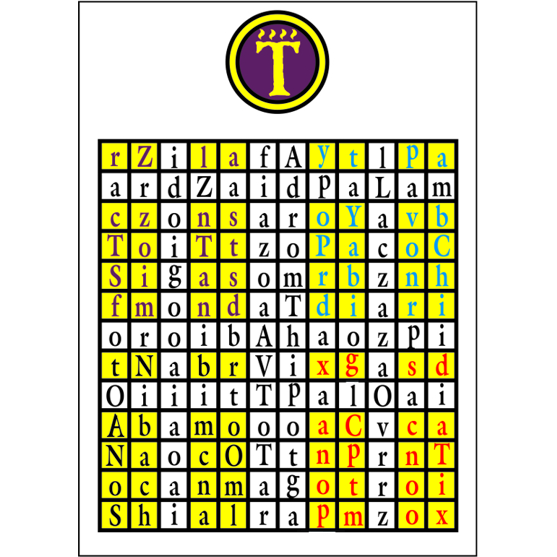
The Air (Eastern) Enochian tablet. Note the Air Lesser Angle, top left.

This I submit is where the mistake, which I mentioned at the top of this article, has crept in. Davidson took an Enochian conjuration and wrongly attributed it to the Key of Solomon! Subsequently, Gray-Cobb incorporated “Arzel” into “New Avatar Power” without realising it was an Enochian being: whilst many others have also taken Davidson’s claim at face value without questioning it.

This does not necessarily invalidate “New Avatar Power,” as – after all – many people have claimed to have some success with it. Perhaps they have discovered an attribution of the Air Lesser Angle of the Air Table albeit unwittingly!
Leave a comment

Filed under Supernatural

On Consecrating A New Water Cup

I stared at the broken fragments in despair: what could have caused my precious Chalice to shatter? I felt particularly galled since it had accompanied me for at least twenty-five years in one form or another. I had to face the unfortunate fact: if I wanted to continue practising ceremonial magick, I would need a new Water Cup

New Water Cup

I immediately decided that in order to do this properly, I would have to cut no corners and consecrate a new Cup in the traditional manner, using the ritual for the consecration of elemental weapons in full form. An unexpected benefit of doing so arose in the form of being able to appreciate this ritual with the benefit of many more years experience. In other words, when an Adeptus Minor first consecrates his tools, it will be not long after he has attained that grade, and hence, presumably, still rather naïve. Whereas I was coming back to it with the benefit of what I had learnt since.

Nowhere was this more obvious than in the realisation that when consecrating the Tools, the new 5=6 is expected to use Enochian magick, the full details of which he is only expected to learn after he has finished consecrating the same Tools!

The actual ceremony is pretty straightforward in structure. There is a general opening: following which there is a three-part invocation for each of the Tools – Wand, Cup, Dagger and Pentacle. The first part is a Qabalistic invocation of the element in general, by appealing to the Hebrew Divine, Angelic and Elemental names most of which are contained in the outer order knowledge lectures.

The second part is Enochian: the Adept is imbuing or linking the Tool with the properties of the specific parts of the Enochian Watchtowers. Firstly: the three secret names of God born upon the Banners of that respective quadrant, as well as the King. The three names (from the Linea Spiritus Sancti) command the spirits of the Tablet in general, whilst the King, whose name spirals around the centre, creates the Invoking Whorl which rouses those spirits to action in the first place. Secondly, the Six Seniors, who represent the planetary energies at work in that Element. Thirdly, the spirits of the individual lesser angles who are each represented by the primary Kerub associated therewith.

When one makes this invocation, one is facing the relevant Enochian Watchtower over the altar on which the Elemental tool is currently resting. Despite the fact that no Enochian calls were being used at this point, I could still sense the presence of the link being made between the Watchtower and the Altar / tool – and the presence of these Enochian beings – simply by calling upon them confidently.

The third part of the invocation is to take the Elemental Tool on its “maiden voyage” as it were, by performing a Supreme Invoking Pentagram Ritual of that particular element whilst using it. This I interpreted as a regular Supreme Invoking Pentagram ritual, but with the addition of an extra Elemental Pentagram to invoke the relevant Lesser Angle of each Watchtower.

After all the tools are consecrated, there is a general closing, with the lesser banishing rituals. As on this occasion I had only consecrated one Tool, I performed an extra Supreme Banishing Ritual Pentagram of that particular Element, before wrapping it in silk – and placing it in a box to make sure it would not suffer the same result as its predecessor.

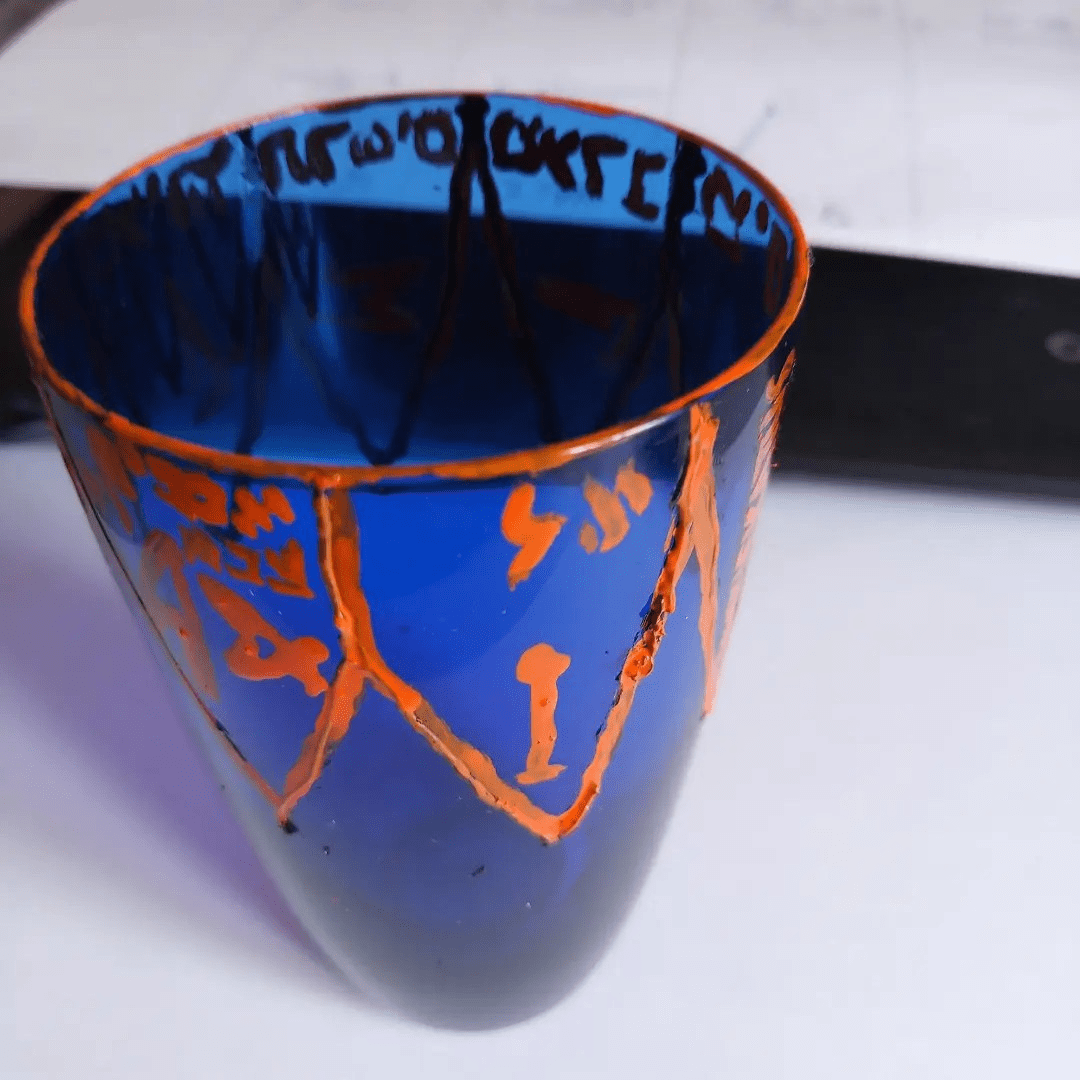
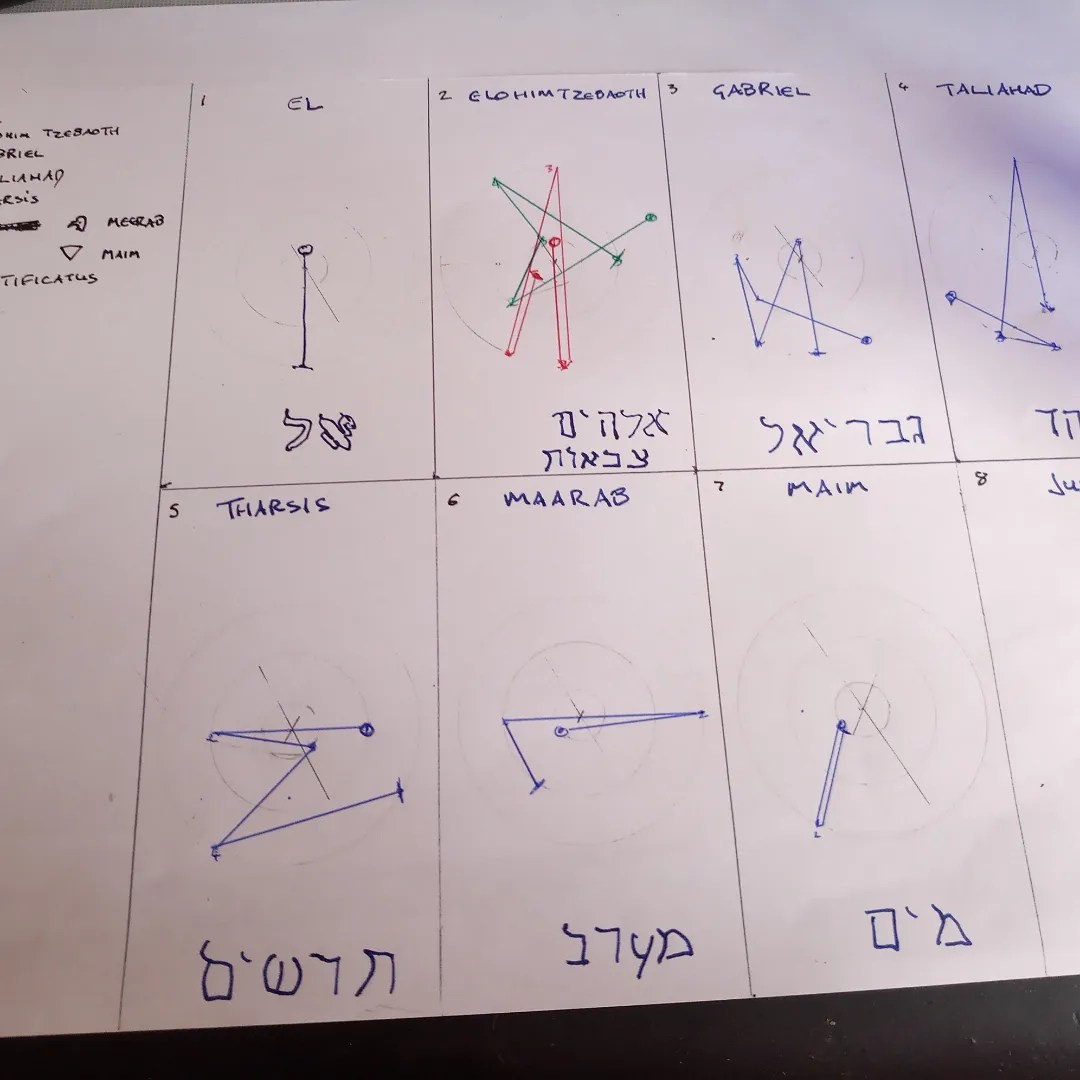
As for my new Water Cup, the hardest part was carefully drawing out all the sigils that I would need to paint on the thing – and use in the ceremony when making the Qabalistic invocation.

Sigils for the element of Water, drawn from the Rose Cross Lamen

Once I had done that, painting the Cup itself was quite straightforward: I used a small tin of orange enamel paint, purchased from an art supply shop; and a tumbler made of blue glass which I had picked up from a charity shop. Total cost of materials approximately £5, and a couple hours of my time. I also printed out the consecration ceremony, making sure that I had figured out the correct pronunciation of the Enochian names involves, so I would not have to resort to guesswork or stumble over a bunch of eldritch consonants in the critical moment.

In conclusion, I cannot help but think of the various arguments for and against whether it is possible to self-initiate into the Golden Dawn tradition. To my mind, the path of the Adeptus Minor itself starts off as a regular initiation, followed by a series of Self-Initiation Rituals in all but name: i.e. when one consecrates ones own lotus wand, rose cross lamen, magic sword, and elemental tools, one is deliberately taking one’s spiritual destiny into one’s own hands.

3 Comments

Filed under Supernatural

Current Work: July 2022

Recently I introduced myself to a group of magicians, saying “You may know me as Alex Sumner.” To which one of them responded by saying “I thought your name was Eric?” I do hope he wasn’t confusing me with other magicians named Eric, but the point is I am partly at fault for not having blogged much recently. I will explain:

Over the past few months I have been particularly concerned with re-visiting my Enochian magic practice. In addition I am now turning towards divination in general, and Tarot in particular. All the while I keep up with my post-Abramelin activities.

Professionally, the manuscript of my next book “Conjuring Demons for Profit and Pleasure” is with the publishers, so that is still going ahead. I’m actually finding that periodically re-reading my magical diaries from whilst performing the Abramelin operation refreshes and re-inspires me.

Leave a comment

Filed under Conjuring Demons for Pleasure and Profit

Enochian Magick: Who Watches the Watchtowers?

What I have to say might sound so shocking that sheer cognitive dissonance will cause many readers to react by crying aloud and saying “No! It can’t be so!” Or: “Surely Alex you must be mistaken?” It is a small detail from Enochian Magick, but important enough to derail one’s entire appreciation of the system if one were to overlook it. It is this:

Everyone who has being doing Enochian Magick relying solely on Aleister Crowley’s texts has been doing it wrong.

Why? Because there is a fundamental mistake in published versions of Liber Chanokh.

The attribution of the Elements to the individual squares of each of the lesser angles has great importance in determining the astrological, tarot, geomantic and qabalistic attributions thereof, as well as each ruling godform. Ultimately, it will affect the vision that one will have if one were to attempt to scry into each square.

The Golden Dawn’s rationale for assigning the elements was stated by Israel Regardie thus:

“Referring to the other squares of the lesser angles, in the Kerubic Rank the outside square is always attributed to the letter corresponding to Element of the Lesser Angle. In the Tablets of Air and Water, the Name read right to left in the upper two quarters; in the two lower quarters it reads from left to right. In the Tablets of Earth and Fire, left to right in the upper, but in the two lower quarters right to left.

Regardie, The Golden Dawn (Emphasis added)

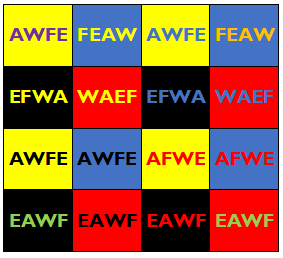
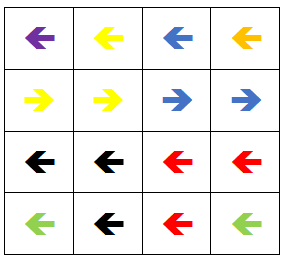
To summarise, the directions would look like this:

Whilst the Elements of the columns would be arranged thus:

However: what appears to have happened is that in published copies of Liber Chanokh, and in versions of the Tablets derived therefrom, the elements appear to have been arranged thus:

The order of the elements in each lesser angle, according to Liber Chanokh.

Spot the difference? This makes it clearer – note the third row, which corresponds to the upper portions (Air and Water lesser Angles) of the Earth and Fire Tablets.

(left) Golden Dawn; (right) Liber Chanokh. Note the third row down.

What appears to have happened is that Crowley (or his illustrator) appears to have interpreted the directions like this:

(left) Golden Dawn; (right) Liber Chanokh. Again, note the third row down.

What is Crowley’s explanation for him ordering the elements in this way? Whilst Regardie set out his rationale in the quote I reproduced above, Crowley however says:

“3. Kerubic Squares.

The upper sides pertain to the element of the Tablet, the lower sides to the subelement. Right- and left-hand sides in this case correspond, according to a somewhat complex rule which it is unnecessary to give here. …

4. Lesser Squares.

The upper side of each pyramid is governed by the Kerub standing on the file above it. The lower side is governed by the Kerub also, but in order descending as the are from right to left above.”

Crowley, Liber Chanokh

“Unnecessary to give here” ! If only it had been given, Crowley’s readers would have found the discrepancy without assistance! If one refuses to believe that Crowley could possibly have made a mistake – perhaps because the aforesaid cognitive dissonance is too much to bear – then the only other conclusion one can draw is that Thelema uses a different version of the Enochian Watchtowers to the Golden Dawn. It is certainly a mistake to think that one can use both the Golden Dawn and Thelemic versions interchangeably.

Golden DawnThelema
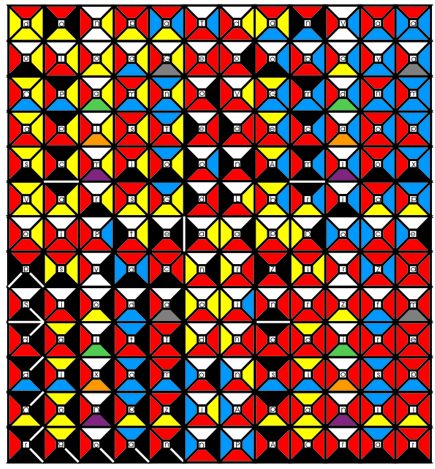
The Southern (Fire) Watchtower

Leave a comment

Filed under Supernatural